ADHD Diagnosis in Women Over 30
Why women with ADHD are diagnosed in their thirties, not childhood.

ADHD in women over 30 is being diagnosed at rates that would have seemed implausible a decade ago, and the reason has nothing to do with a sudden rise in the condition itself. The diagnostic framework was built around hyperactive boys in classrooms, and women's symptoms, largely inattentive and internal, simply didn't register on that scale. What follows is the anatomy of that gap: how big it actually is, what it costs, and what's now known about closing it.
How large the gap is, and that it is closing, slowly
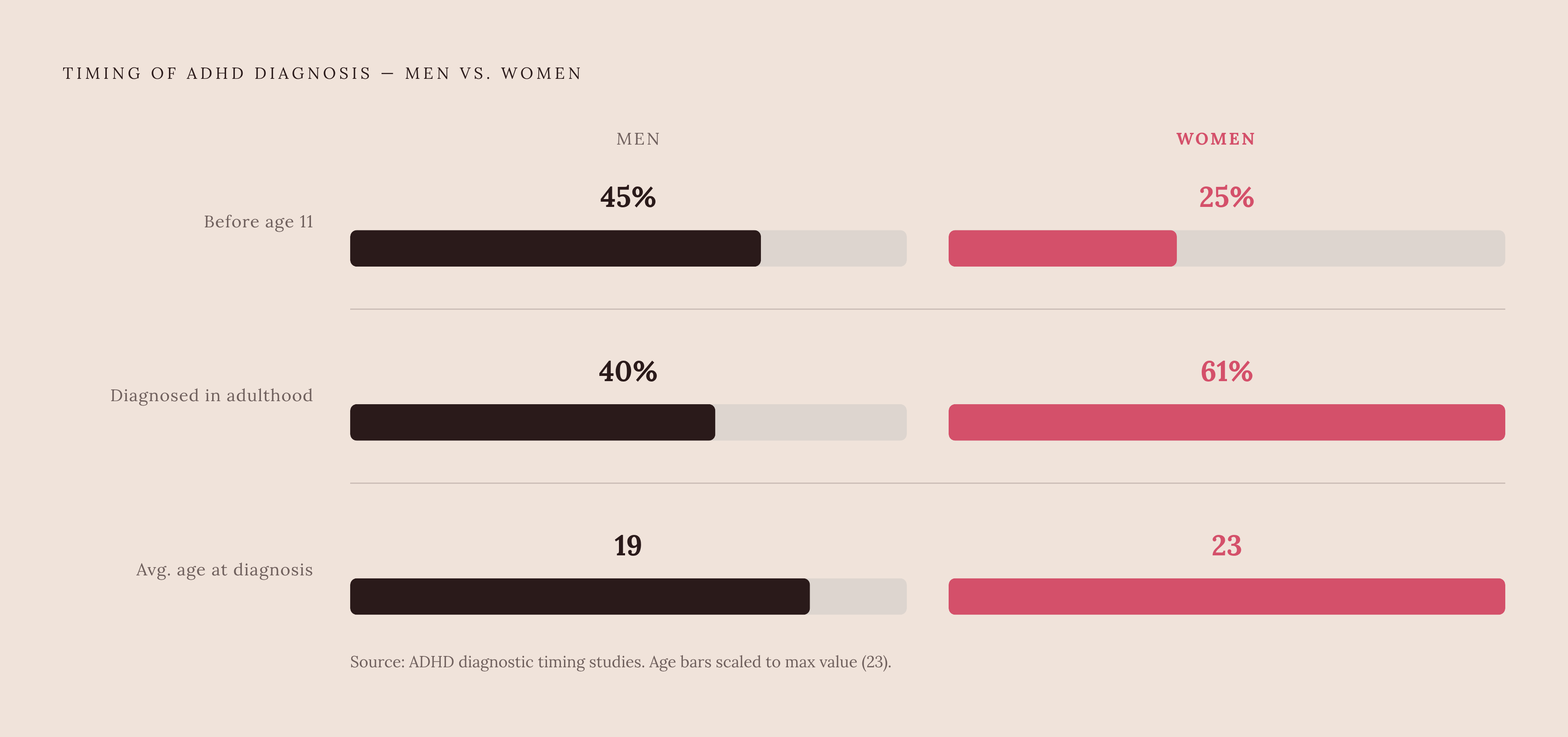
The clearest evidence of the problem is timing. According to the CDC's MMWR report, its first update on adult ADHD prevalence in nearly two decades, 61% of women diagnosed with ADHD received that diagnosis in adulthood, compared with 40% of men. Only 25% of women were diagnosed before age 11, versus 45% of men. That's not a small skew. That's two different diagnostic experiences happening under the same label.
A study tracking more than 85,000 people with ADHD, cited by Charlie Health, found girls were diagnosed and treated roughly four years later than boys on average, at age 23 versus 19. Clinical accounts suggest the real-world pattern often runs even later, with many women not receiving a diagnosis until well into their 30s or beyond. So the four-year gap in that study is arguably a conservative estimate of what's happening at the population level.
But the picture isn't static, and this is where it gets interesting. Epic Research, drawing on a large multi-patient dataset, found that ADHD diagnosis incidence in women aged 23 to 29 and 30 to 49 nearly doubled between 2020 and 2022. The male-to-female diagnosis ratio tells the same story from a different angle: in 2010, men were 133% more likely to be diagnosed than women. By 2022, that gap had narrowed to 28%. That's not a modest shift, it's a near-collapse of a disparity that held for decades.
Should this be read as a diagnostic trend, something new and fashionable? Almost certainly not. It reads more like decades of suppressed demand finally being met by better clinical awareness and, frankly, by women comparing notes with each other in ways earlier generations couldn't. For context on the broader adult population: the CDC's rapid survey found 55.9% of all adults with a current ADHD diagnosis received it in adulthood, and roughly 6% of adults in the country. adults, about 15.5 million people, currently carry the diagnosis. The gender gap has narrowed. It hasn't closed. And the diagnostic criteria that created the gap in the first place haven't been meaningfully reformed.
What ADHD looks like in women, the symptoms that get missed or mislabeled
Inattentive ADHD dominates the female presentation, and it is, by design, harder to catch. Trouble sustaining focus. Zoning out mid-conversation. Losing track of bills, appointments, keys. Avoiding tasks that feel overwhelming, not because of laziness but because starting them triggers something closer to dread. The accompanying texture is well documented: chronic lateness, a persistent feeling of being behind, exhaustion that doesn't resolve with sleep.
Then there's the emotional layer, which is often what actually gets a woman into a clinician's office, just aimed at the wrong diagnosis. Emotional dysregulation, intense reactions that are hard to downshift from, is rooted in a fairly specific neurobiological profile: an overactive amygdala paired with an underactive prefrontal cortex. Recent research points to specific neurobiological patterns that help explain the link between ADHD symptoms and this kind of emotional volatility. On the surface, this looks exactly like a mood disorder. The ADHD underneath causes anxiety and depression to get diagnosed and treated, sometimes for years, while it goes completely unaddressed.
Masking makes all of this worse. Girls learn early, often before they can articulate why, to suppress and compensate: over-preparing, over-apologizing, smoothing over every visible sign of struggle. That's expensive. Masking burns energy, taxes working memory that's already stretched thin, and speeds up burnout. It also wrecks the reliability of a standard diagnostic observation, because the woman sitting in the clinician's office looks fine. She's spent thirty years learning how to look fine.
Layer onto this the common co-occurring conditions documented in the literature (anxiety, depression, eating disorders, chronic sleep disruption, compulsive behaviors) and the clinical picture becomes genuinely difficult to untangle. DSM criteria require symptoms present in two settings along with a history beginning before age 12, and this requirement produces the structural problem running through all of it. For a woman who masked her way through childhood, the only evidence available is her own retrospective account, and that account is rarely asked for.
Why the 30s are when it tends to surface, the hormonal layer most clinicians miss
Estrogen isn't just a reproductive hormone. It's a modulator of dopamine and serotonin, increasing synthesis of both and limiting their reuptake, according to research cited by pmc.ncbi.nlm.nih.gov. When estrogen drops, attention, memory, mood, emotional regulation, and sleep all take a hit simultaneously. That's the direct neurochemical bridge between hormonal fluctuation and ADHD symptom severity, and it's not something most general practitioners are trained to look for.
This matters enormously because perimenopause seems to arrive earlier in women with ADHD than in the general population. A 2026 study of 5,392 women in the Icelandic SAGA cohort found considerably higher symptom burden among women with ADHD, with the differences most pronounced between ages 35 and 39, suggesting perimenopause onset up to ten years earlier than average. Worsening inattention, sharper emotional dysregulation, brain fog, memory lapses, disrupted sleep, vasomotor symptoms: all of it lands in a decade already stacked with other pressure.
Because the 30s bring their own load regardless of hormones. Careers demand more, domestic responsibilities tend to peak, and children start getting their own ADHD diagnoses, which is often the moment a mother recognizes the same patterns in herself. What gets labeled burnout, or a new anxiety disorder that appeared out of nowhere, may actually be ADHD that's been present for decades finally exceeding a coping margin that's been shrinking for years.
Clinicians remain underprepared in part because fewer than 1% of all brain imaging studies focus on female-specific health factors, according to ADDitude, which means the hormonal dimension of ADHD is barely documented in the literature clinicians actually train on. That gap in the research becomes a gap in the exam room. Left undiagnosed, women moving through this period also face heightened vulnerability to premenstrual dysphoric disorder, postpartum depression, and cardiovascular disease, per research indexed on pmc.ncbi.nlm.nih.gov. So the cost of missing ADHD in the 30s isn't confined to the 30s.
What decades of undiagnosed ADHD costs, the executive function picture in adult women
Executive function is the umbrella term for a specific set of cognitive skills: working memory, cognitive flexibility, impulse control, task initiation, planning, time management, emotional regulation, self-monitoring. ADHD is, at its core, a disorder of these functions, which is precisely why it touches nearly every part of adult life rather than staying contained to one domain.
A 2025 finding, published in 2026 and indexed on PubMed, shows that women with ADHD consistently report greater impairment than their objective test performance would predict. There's a persistent gap between what they say they're struggling with and what standardized measures capture. That gap suggests something uncomfortable, that the functional burden of ADHD in women is being systematically underestimated even inside the research meant to quantify it.
Longitudinal research adds another layer. Studies tracking women with ADHD over time suggest that coping strategies can reduce visible symptoms without closing the underlying executive function gap. Coping doesn't close that underlying gap. It just makes the gap less visible, which is a very different thing.
The productivity toll is measurable too. WHO-sourced research puts the figure at 22 excess days of lost productivity per year for workers with ADHD compared to peers without it. But the number that no dataset captures is the cumulative shame: decades of being called lazy, scattered, too sensitive, unreliable, internalized not as a neurological pattern but as a character flaw. Self-esteem, relationships, entire career trajectories get shaped around a misattribution that was never accurate in the first place. A late diagnosis reframes that history. It doesn't undo it. What changes is the framework going forward, not the years already lived inside the wrong one.
Task paralysis, the symptom that explains why knowing what to do isn't enough
Task paralysis gets confused with procrastination constantly, and the two are not the same thing. Procrastination is avoidance by preference, a choice, even a comfortable one. ADHD task paralysis is closer to a neurological freeze, and it often triggers an actual stress response rather than a simple delay. The person doesn't put the task off. She locks up in front of it.
Working memory deficits, time blindness, and a genuine difficulty predicting how long or how complex a task will turn out to be, all three combine to produce a kind of mental shutdown, even on tasks she wants to finish. A peer-reviewed study in European Psychiatry (August 2025), covering 50 adults with ADHD, found 82% reported frequent difficulty with decision-making, and 68% said decision paralysis significantly affected their work performance. Those aren't small numbers for a symptom that rarely gets named directly.
Perfectionism throws fuel on this. Fear of producing something imperfect leads to refusing to start at all, which means nothing gets done, which then confirms whatever self-criticism was already sitting there waiting. For women who spent decades compensating through perfectionism specifically, because it was one of the few strategies that reliably masked the underlying struggle, this loop is deeply worn in.
What makes this worse than a productivity problem is how it reads to other people, and eventually to the woman herself: as incompetence, as not caring enough. That reading reinforces the exact misattribution that's been building since childhood. But the more accurate read is different. The ADHD brain isn't unmotivated. It's waiting for a signal strong enough to initiate movement, and willpower alone rarely produces that signal.
What helps, strategies designed around how the ADHD brain initiates and sustains action
The same design principle produces every effective strategy: reduce ambiguity right at the point of initiation, because that's precisely where ADHD breaks down. The gap between intending to do something and actually doing it is the whole battlefield. Structured planning removes the working memory burden of figuring out what to do first. Breaking a task into concrete steps removes the cognitive overhead that triggers the freeze. Accountability check-ins, per ADHD coaching research, build external scaffolding around a system that struggles to generate its own starts.
A few tactics appear again and again in the literature. The five-minute commitment, agreeing to work on something for just five minutes, bypasses the emotional wall that builds up around starting. A daily brain dump, writing down everything sitting in working memory, clears the clutter and gives the brain an actual starting point. Prioritization frameworks like the Eisenhower Matrix cut down decision paralysis before the day even gets going. And structured CBT, as established in peer-reviewed ADHD treatment literature, gives a formal path through overwhelm back toward some control over a schedule.
Gamification deserves more respect than it usually gets in this context. It's not a gimmick bolted onto productivity software. ADHD brains run on a disrupted dopamine pathway, which means they default toward immediate-reward tasks and avoid anything low-stimulation, no matter how important it is. XP systems, milestone tracking, visible reward loops: these manufacture the motivational signal the brain isn't generating on its own. Small increments of visible progress keep engagement going well past the point where novelty alone would've faded.
Friction matters just as much as motivation. Standard task apps require opening the app, navigating menus, typing, organizing, and every single one of those steps is a place where the thread gets dropped. Voice-first tools remove a lot of that initiation cost, since thinking out loud is already how many ADHD brains process information; capturing that thought directly skips the translation step that so often causes the whole task to get abandoned. Apps built specifically around ADHD behavioral science, with milestone breakdowns, guided goal planning, and habit scaffolding built in, are solving the actual mechanism of the problem rather than just giving someone another list to ignore. Access has improved too: 46% of adults with ADHD have used telehealth to manage the condition, which has lowered the barrier considerably for people who spent years falling through the cracks of a system that assumed everyone could show up to an office during business hours.
What a late diagnosis gives you, and what to do with it
A diagnosis at 35, or 42, or 50 isn't late. It's the first accurate explanation for a lifetime of experience that never had a name attached to it. Every job that felt impossible for reasons no one else seemed to struggle with, every relationship strained by disorganization that got read as carelessness, every morning spent frozen in front of a task that should have taken twenty minutes, all of it gets recontextualized the moment the framework changes.
That doesn't rewrite the years already spent believing the wrong story. But it does change what happens next. Treatment, whether medication, coaching, structured behavioral strategies, or some combination, works on the actual mechanism rather than managing symptoms of a misdiagnosis that was never the real issue. The shame that built up over decades starts to lose some of its grip once it's understood as a response to an unrecognized neurological pattern rather than evidence of a personal failing.
What matters most in the diagnosis itself is what gets built on top of it. Understanding the mechanism, working memory limits, time blindness, the initiation gap, dopamine-driven motivation, turns vague self-criticism into something specific and workable. That's the real value of the diagnostic gap finally closing: not just more accurate paperwork, but a generation of women getting the chance to understand a system that was working differently all along, and finally building strategies that work with it instead of against it.