Body Doubling as an ADHD Mental Health and Productivity Tool
Body doubling activates dopamine pathways in ADHD brains, making hard tasks easier to start.
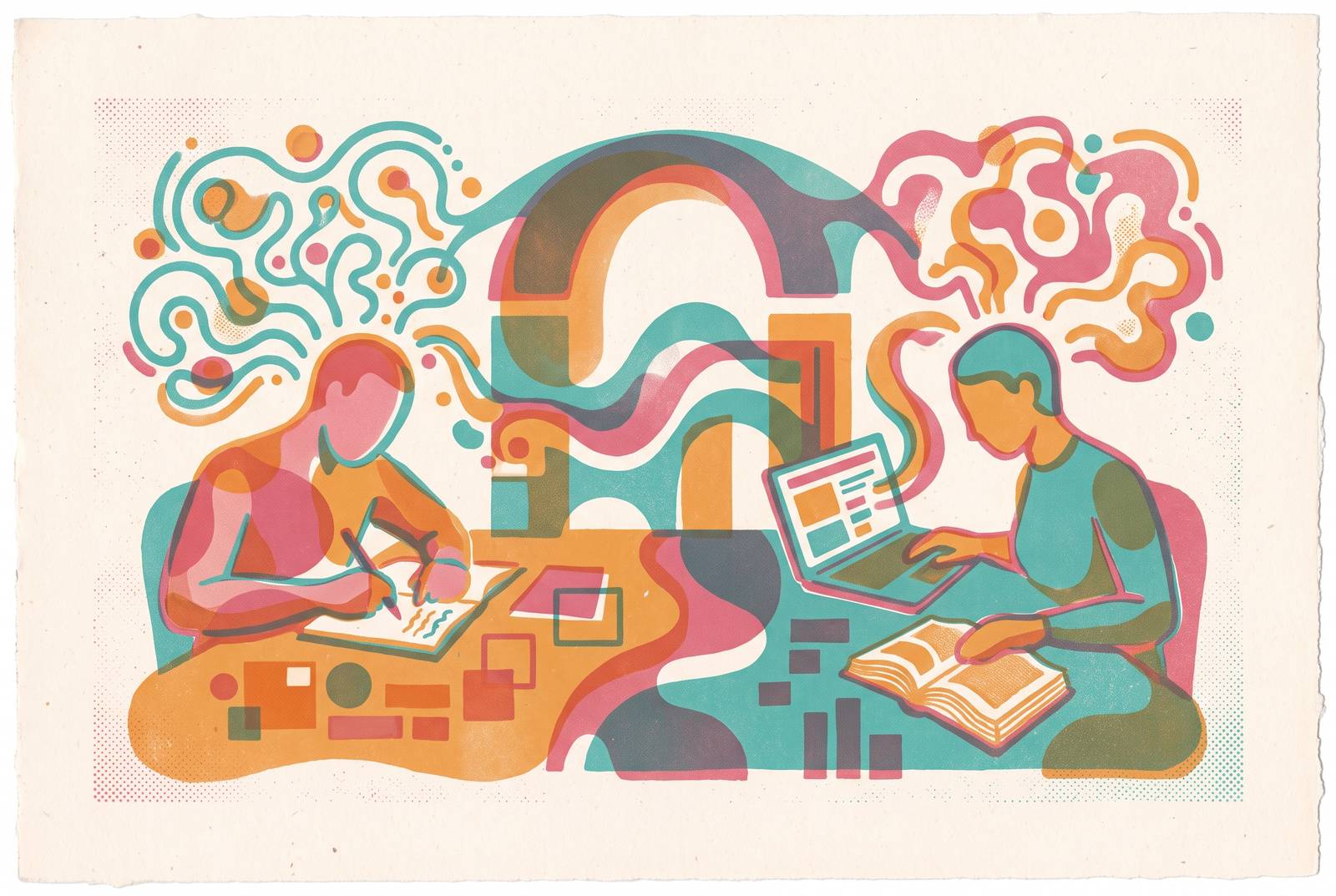
Body doubling means working on a task while another person is present, physically or virtually, without that person helping, checking in, or even paying attention to what's being done. The only job of the body double is to exist nearby while someone else works, and that presence alone is enough to change how the ADHD brain approaches a task. The term traces back to 1996, when ADHD coach Linda Anderson first described the practice in an article, which ADDA republished on February 20, 2025.
A body double can be a partner typing away at the other end of the couch, a stranger matched through a video call, or a pre-recorded video of someone else quietly doing dishes. The format changes. The mechanism, evidently, does not. That flexibility is part of why the concept has outlived plenty of other ADHD productivity fads: it scales from a coffee shop table to a fully asynchronous YouTube video, and the "Study With Me" genre, including channels like Lofi Girl, has been cited directly in the academic literature as a working example of body doubling in practice⟧c4⟧. Some of these videos run for hours, silent except for ambient sound, and the viewer supplies the sense of being watched even though the person on screen has no idea they exist.
The Struggle to Start and Sustain Tasks Without External Scaffolding in ADHD Brains
ADHD is, at bottom, a disorder of executive function. It's a disorder of executive function, the set of cognitive processes responsible for organizing, prioritizing, starting, and following through on tasks, and that distinction changes how the condition should be treated and understood. The prefrontal cortex in an ADHD brain runs on reduced dopamine signaling, which directly impairs the ability to prioritize, inhibit impulses, and switch between tasks smoothly. More than 15 million people in the US meet the diagnostic criteria for ADHD, and a meaningful share of them report that starting a task, not finishing it, is the hardest part https://add.org/the-body-double/ https://arxiv.org/pdf/2509.12153.
Several clusters of executive function break down in predictable ways. Activation is the ability to organize a task, estimate how long it will take, and actually begin, and it is often the first casualty. Focus is another: not just paying attention, but sustaining it, and then shifting it cleanly from one task to the next. Emotional regulation, effort regulation, memory, and action regulation round out the list, and all of them draw on the same dopamine-starved circuitry.
It gets uncomfortable for anyone who has been told to just try harder. Dysregulated dopamine and norepinephrine make boring or delayed-reward tasks feel physically unpleasant to begin, even when the person genuinely wants to do the work and understands its importance. It's a neurochemical problem, not a motivation problem in the conventional sense. It's a neurochemical one. Adding too many steps to a task means the brain doesn't budget for them; it simply overloads and shuts down, a state usually called task paralysis. None of this is laziness, and none of it is a character flaw. It's a downstream effect of how the ADHD brain regulates reward and effort, and that reframing is why body doubling works as well as it does: it supplies externally what the brain can't reliably generate on its own.
The neurological reason another person's presence changes everything
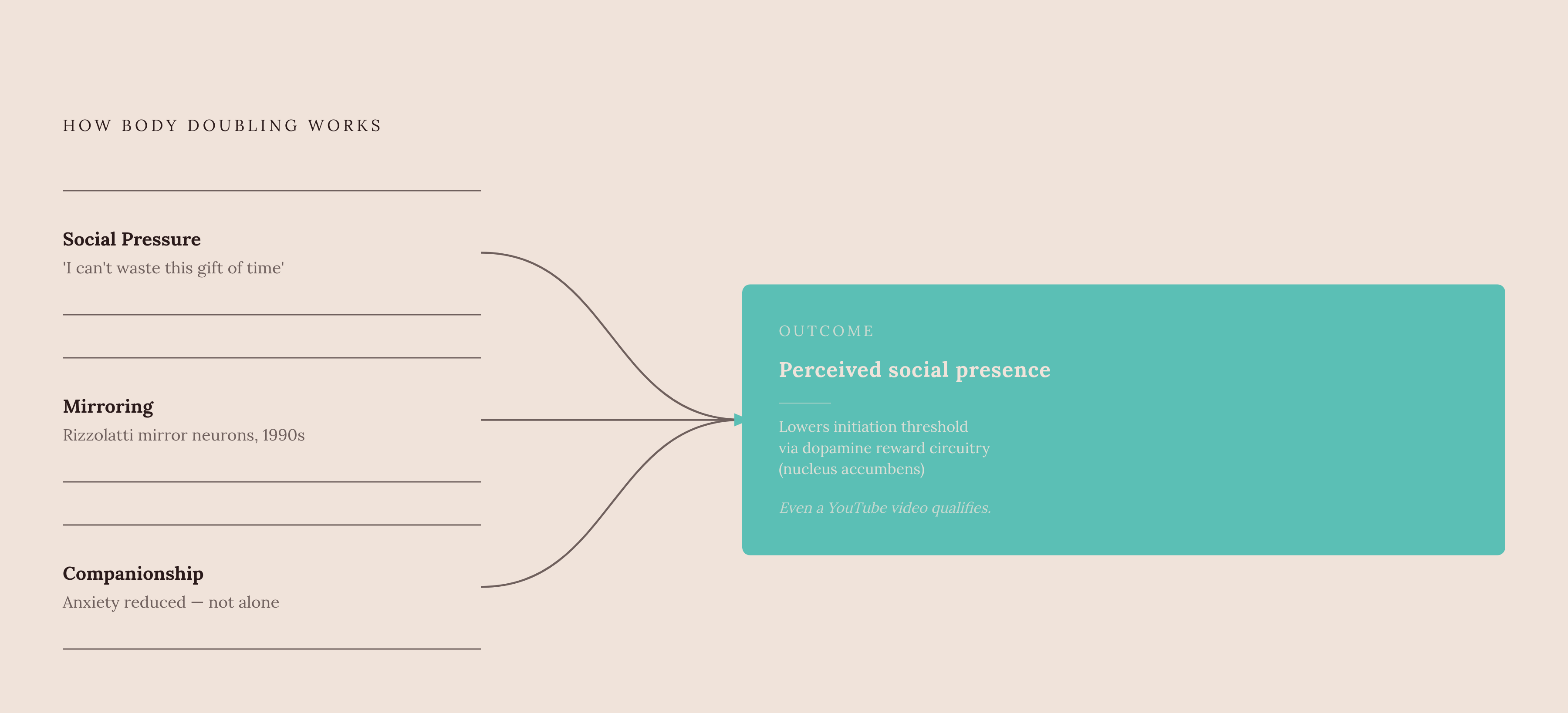
So why does another person sitting quietly nearby make a boring task suddenly possible to start? The leading explanation is that mere presence, just having someone else in the room or on the screen, activates dopamine reward circuitry in the ADHD brain, and that activation lowers the threshold needed to initiate a task. Social interaction more broadly is known to activate dopamine reward pathways in the nucleus accumbens, and given that ADHD's core issue is dysregulated dopamine signaling in the prefrontal cortex and striatum, the overlap is not a coincidence.
Three mechanisms get named most often in the research. The first is social pressure, sometimes described by users themselves as "I can't waste this gift of time," a sense of accountability that comes purely from being observed. The second is mirroring: watching someone else stay focused seems to unconsciously nudge the viewer toward the same behavior, a pattern researchers connect back to mirror neuron work from Giacomo Rizzolatti in the 1990s. The third is companionship, the simple reduction in anxiety that comes from not facing a hard task entirely alone.
None of these mechanisms appear to require an actual human being in the room. A 2025 VR study found that participants working with an AI body double showed the same pattern of faster task completion and greater perceived sustained attention as those paired with a real person, both outperforming the condition where subjects worked alone. That finding, if it holds up under further testing, suggests the active ingredient isn't companionship in the traditional, relational sense. It might just be perceived social presence, full stop. That changes what kind of tool this actually is.
The evidence for body doubling and its limits
A 2024 study published in ACM Transactions on Accessible Computing (doi:10.1145/3689648) was the first formal peer-reviewed investigation focused specifically on body doubling, and it found that neurodivergent participants "overwhelmingly used the practice to help initiate, stay motivated during, and complete tasks," establishing body doubling as evidence-supported rather than purely anecdotal. Neurodivergent participants in that study overwhelmingly reported using the practice to initiate tasks, stay motivated through them, and see them to completion, which shifted body doubling from a well-loved coping strategy into something with actual evidentiary backing.
A separate 2024 survey of 220 neurodivergent participants found that 85% reported significant improvement in task completion when using body doubling https://www.accountablo.com/blog/body-doubling-apps. One study within that broader research effort ran with just 12 participants, a small sample given how much weight gets placed on the percentage figures that come out of studies this size https://arxiv.org/pdf/2509.12153.
Physiological evidence is starting to catch up with self-report data too. An EEG study involving 26 participants was among the first to directly measure brain activity during body doubling sessions, rather than relying on what participants said afterward. What the research currently supports is that body doubling works, reliably, across multiple study designs. What it can't yet fully explain is precisely why, or which of the three theorized mechanisms, social pressure, mirroring, or anxiety reduction, does most of the heavy lifting. A 2025 VR study found that tasks were finished faster, with greater perceived accuracy and sustained attention in body double conditions (C2 human, C3 AI) versus alone (C1), yielding 27–30% faster task completion compared to working alone.
The spectrum of body doubling formats, from in-person to AI
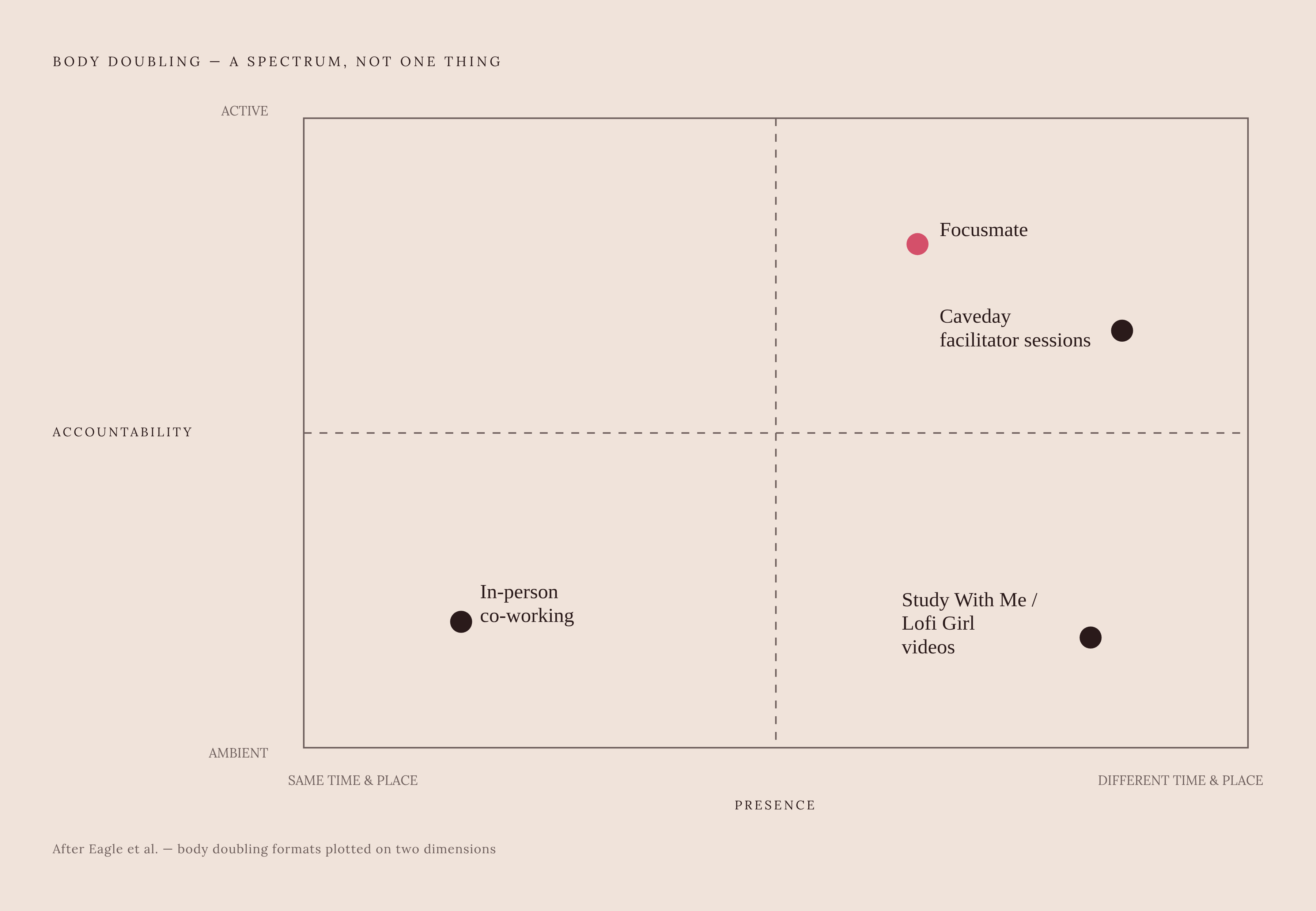
Rather than picturing body doubling as one fixed activity, it helps to imagine it plotted across two axes. Researchers Eagle et al. proposed a two-dimensional model: one axis runs from same time and place to different time and place, and the other runs from ambient companionship to active accountability. That framework does more useful work than a simple list, because it shows that "body doubling" covers a wide range of experiences that share only the presence variable in common.
At the same-time, same-place, ambient-companionship end sits the most informal version: a friend, partner, or colleague working on something unrelated in the same room. Coffee shops and libraries function as passive, low-stakes versions of this, where the accountability comes from being surrounded by other focused people rather than from any direct interaction. Moving along the space and time axis toward "different time, different place" brings asynchronous formats to the fore. "Study With Me" videos on YouTube fall here, and Lofi Girl stands as a confirmed example in the academic literature, requiring the viewer to build their own mental bridge between the video and their physical surroundings since there's no live feedback loop at all.
Virtual, live platforms occupy the middle ground: real-time interaction, but remote, sitting between the informality of a shared room and the total detachment of a pre-recorded video. That middle segment is where most of the dedicated commercial tools live.
Virtual body doubling platforms: what each one offers
Focusmate is generally considered the original dedicated virtual body doubling platform. The format is straightforward: book a session, get matched with a partner, briefly state what's being worked on, then work silently together with cameras on for the duration. Pricing includes a free tier capped at three sessions per week, and a Plus tier at $8 a month billed annually that unlocks unlimited sessions. An internal survey cited by Dealroom attributes a 143% productivity increase to the platform's method, though that figure comes from Focusmate's own data rather than a peer-reviewed study, and should be read with that limitation in mind https://app.dealroom.co/companies/focusmate.
That's a meaningfully different experience from silent, unstructured co-working: less ambient, more directive.
Flow Club runs on a community-hosted model, with sessions run entirely by community members rather than paid facilitators, and it currently offers more than 2,000 sessions per week https://www.pledgd.com/blog/body-doubling-apps. Caveday, by contrast, is built for people who want ritual and structure layered onto the deep work itself: facilitator-led focus sessions sit alongside planning workshops, events, and broader tools aimed at reshaping someone's overall relationship with work, not just a single afternoon of it.
None of these four are competing for exactly the same user https://arxiv.org/pdf/2605.07851 [1][2]. Someone drawn to a more communal, less transactional feel might prefer Flow Club. The right fit depends less on which platform is "best" and more on how much structure a given person's ADHD brain actually needs on a given day, which is not a fixed quantity. Session lengths on offer are 25, 50, or 75 minutes.
How body doubling pairs with other condition-specific strategies to compound its effect
Body doubling solves for initiation and sustained presence. It does not, on its own, make an overwhelming task smaller, and that's an important limit to sit with. Recall the earlier point about task paralysis: the brain shuts down when it perceives too many steps, and a body double sitting quietly nearby doesn't reduce the step count. So body doubling works best when it's paired with something that actually restructures the task itself, and breaking a task into smaller milestones is the most direct way to remove the overload that triggers paralysis.
The Five-Minute Rule pairs naturally here: commit to just five minutes of work, then reassess whether to continue. Body doubling supplies the social presence and the accountability; the five-minute rule strips away the perceived enormity of the task before the presence effect even has to do its work.
The Pomodoro Technique offers a similar case for pairing, with a caveat. Its traditional 25-minute block can itself become a barrier for some ADHD brains, either too rigid or too long depending on the day, so the technique tends to work only once it's modified to fit the person rather than the other way around.
Time blindness deserves its own mention, since it's one of the more underappreciated executive function deficits in ADHD. Abstract to-do lists don't work well against time blindness because they carry no sense of duration or urgency. A body doubling session with a defined start and end time functions as an external clock, anchoring a task in real, felt time rather than an open-ended list item that could theoretically stretch forever.
Who body doubling works for
Body doubling is not a universal fix, and the research is honest about that. The 2025 VR study led by Ara et al. found that while participants clearly preferred body doubling over working alone, opinions split when comparing the human condition to the AI condition, so the effect is not uniform across people or across formats. Some people wanted the specific texture of human presence. Others didn't seem to care whether the entity on the other side of the screen was a person or a program, as long as something was there.
That divergence matters most for a specific group: people whose ADHD comes bundled with social anxiety. For them, a live, matched-partner format like Focusmate's cameras-on session can become its own stressor, undermining the exact calm the practice is supposed to produce. Prior research has flagged this discomfort with social presence directly. It's not a minor footnote. If the tool designed to reduce anxiety around a task instead adds anxiety about being watched, it has failed at its one job.
That tension is precisely what motivated the Malmö University chatbot prototype, built specifically for this population as a non-judgmental, no-pressure alternative to a live human partner. Task type matters too. Body doubling is most consistently effective for tasks that require sustained, solitary effort, desk work, administrative tasks, studying, household chores. It's far less clear whether it helps with tasks demanding deep creative solitude, or work that gets interrupted constantly regardless of who else is in the room. So the honest answer to "does body doubling work" is: for a lot of people, on a lot of tasks, yes, reliably. For everyone, on everything, no. And knowing where that line sits for a given person is worth more than blanket enthusiasm.
Using body doubling more intentionally: practical guidance for getting started
Start with the task. A messier, more physical task, cleaning a room, tackling a pile of laundry, benefits from pre-recorded options built for exactly that kind of work, since no scheduling or live matching is required.
Try that before assuming the live, human version is the only "real" option.
Layer in the Five-Minute Rule at the start of any session, human or AI: commit to just five minutes, then reevaluate, since body doubling provides the social presence and the five-minute rule removes the perceived enormity of the task. The goal isn't finding the one correct method. ADHD participants who worked alongside a body double showed 27–30% faster task completion compared to working alone https://getadhdtest.com/en/blog/adhd-body-doubling-focus-strategy/. ADHD individuals are 30% more likely to face chronic employment difficulties https://arxiv.org/pdf/2509.12153.
Sources
- A Roadmap of Mixed Reality Body Doubling for Adults with ADHD
- The ADHD Body Double: A Unique Tool for Getting Things Done - ADDA - Attention Deficit Disorder Association
- You Are Not Alone: Designing Body Doubling for ADHD in Virtual Reality
- “It Was Something I Naturally Found Worked and Heard About Later”: An Investigation of Body Doubling with Neurodivergent Participants | ACM Transactions on Accessible Computing
- accountablo.com
- pledgd.com
- getadhdtest.com