ADHD Habit Building Apps Compared by Behavioral Science Approach
ADHD apps work better when they target planning breakdowns, motivation gaps, or both.
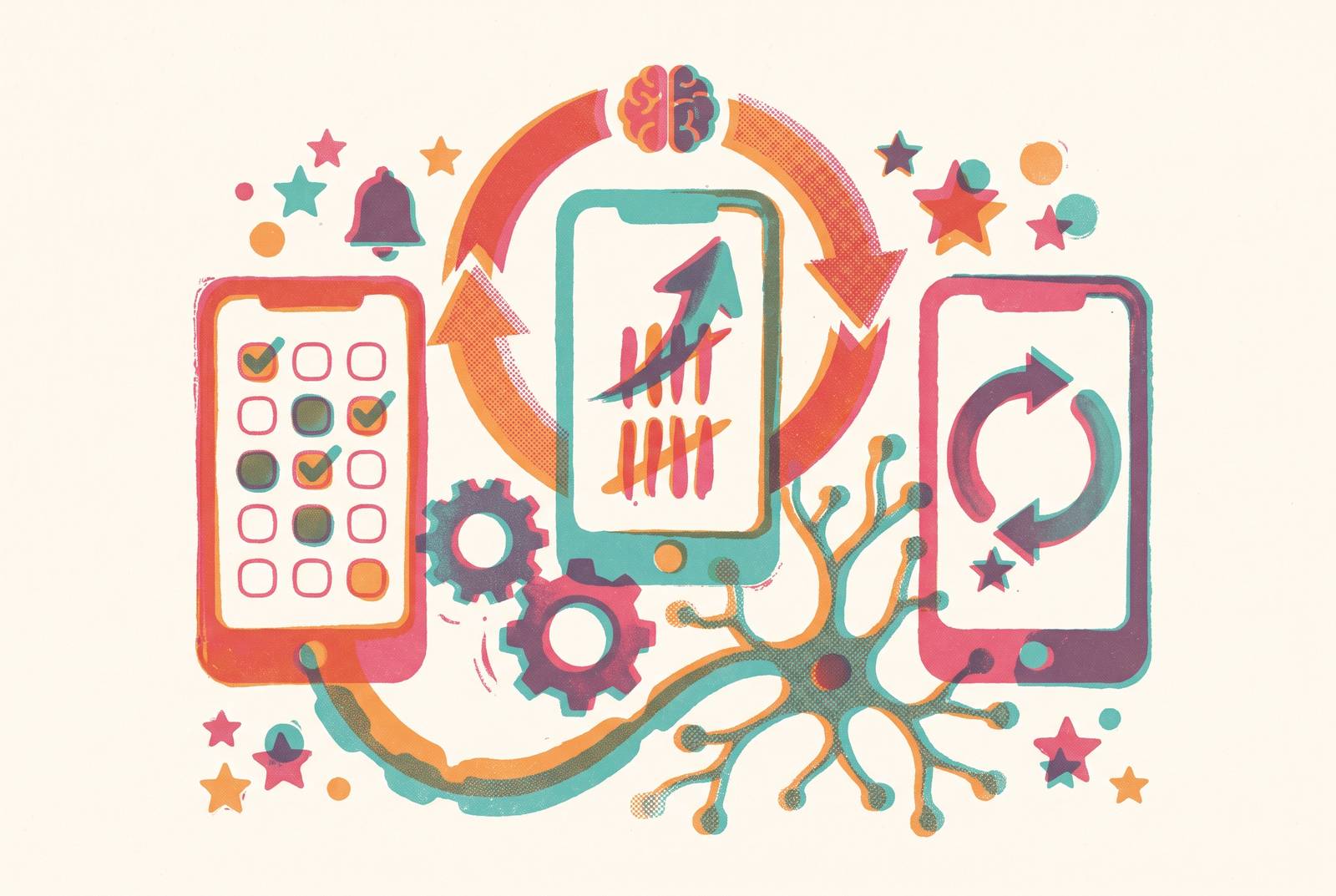
ADHD habit-building apps are best compared by the failure they address. Task decomposition helps with planning, immediate rewards help with motivation, and non-punishing routines make it easier to return after a routine breaks down. The strongest fit depends on where habits break down for you, with low-friction capture as the prerequisite that lets every other mechanic work.
Why ADHD habit-building fails before any app enters the picture
Knowing what to do does not reliably produce action in ADHD. The gap is not simply insufficient effort. Habit-building depends on dopamine-driven reward anticipation, inhibitory control, and working memory, all of which can be disrupted in ADHD. That leaves the usual promise of a habit tracker unfulfilled, because writing down an intention does not bring back the processes needed to act on it.
Siqueira et al. in European Psychiatry (2025) describe ADHD-associated hypofunctioning of the prefrontal cortex and its connections, which support self-control and goal-directed activity. Yang et al. in Frontiers in Psychiatry (2026) examine three core executive functions, namely inhibitory control, working memory, and cognitive flexibility, in research on children and adolescents with ADHD. Keeping a goal in mind, resisting a distraction, and switching activities place different demands on that system.
The ability is still there, but it does not work reliably. Planning can work one day and become unreliable the next, which helps explain why one successful routine does not establish that the next failure was a choice. Siqueira et al. also report that more ADHD symptoms correlate with longer interference reaction times and lower quality of life in social relationships. The burden varies with the person and the circumstances. An app that depends on consistent use therefore asks for the very capacity it should help support.
Why "cool" executive dysfunction alone does not explain why apps fail ADHDers
Planning support addresses only part of the problem. Research distinguishes “cool” executive functions, including inhibitory control and working memory, from “hot” executive functions, including delayed gratification and reward processing. A checklist can make the next action clear without making that action feel worth starting. Representation and motivation are different design problems.
The prefrontal cortex supports cool executive skills, while the ventral striatum is involved in reward anticipation. Reduced activation during reward anticipation in ADHD helps explain why an important but unrewarding task may not generate enough impetus to begin. An orderly calendar does not necessarily change that. An app therefore needs to be evaluated for how clearly it presents a task and how well its reward structure helps turn understanding into action.
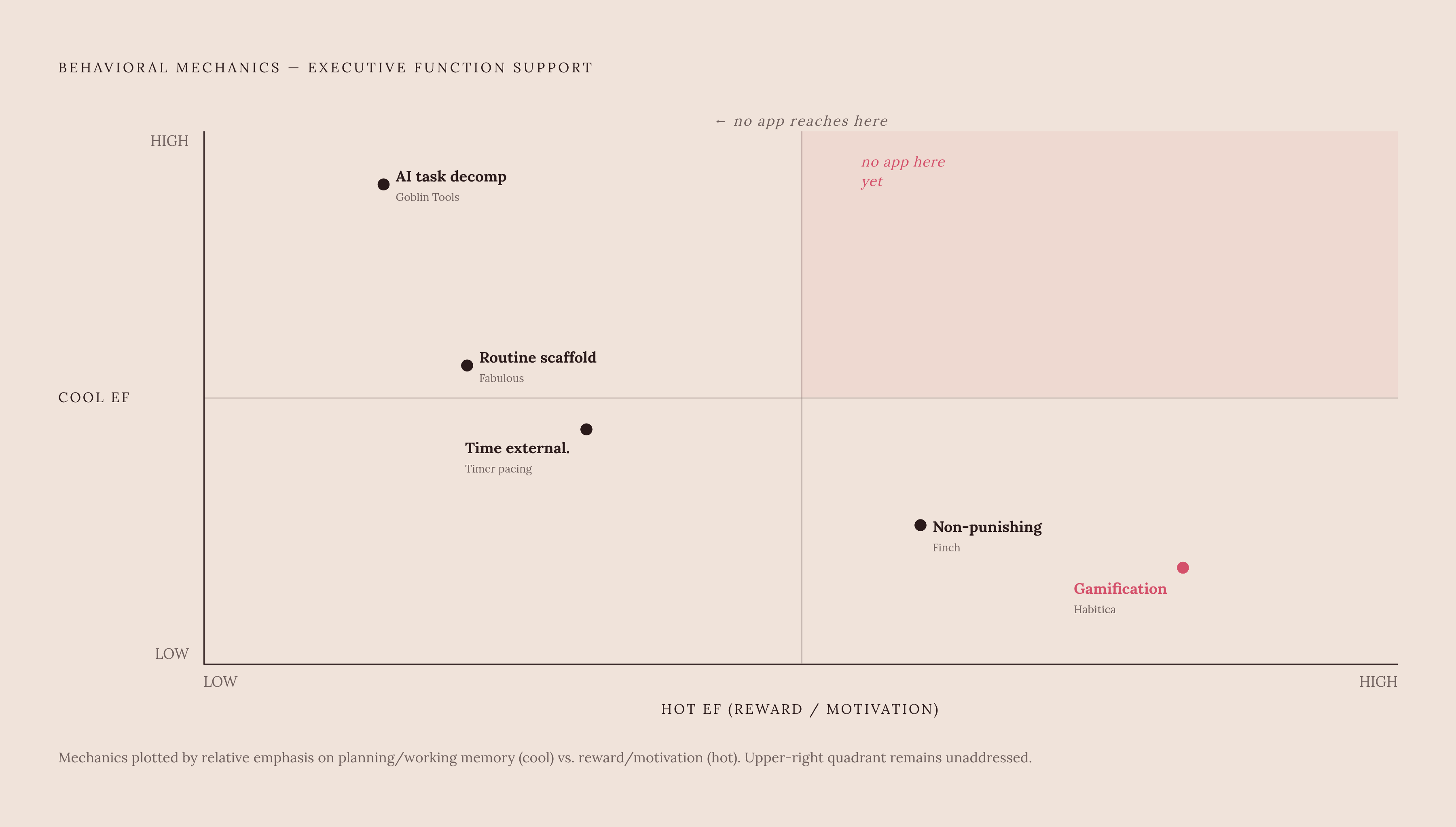
Petrovic, Skoglund, and Sonuga-Barke in Frontiers in Psychiatry (2025) emphasize functional heterogeneity and the limited translational progress of disorder-specific deficit models. That framing cautions against treating ADHD users as a single motivational profile. Some need more planning support, while others need a stronger reason to engage with an already clear plan. This comparison uses a two-axis framework to ask how well each app’s core mechanic helps with cool executive function deficits, hot executive function deficits, or both.
The five behavioral science approaches apps actually use, and what each one is doing neurologically
Gamification manufactures an immediate reward for task completion. Its target is the hot executive function gap. Points and game-based progress attempt to make an otherwise unrewarding action more competitive with distraction, rather than relying on a distant benefit to motivate it. The reward must be sufficiently engaging and frequent for the user. Complex game systems can, however, become a focus in themselves, and game mechanics do little to help someone who does not enjoy them.
Non-punishing design removes a different obstacle to continued engagement. Streak-loss penalties can turn ADHD’s inconsistency into a repeated experience of failure, encouraging shame and abandonment. Removing those penalties keeps the interface from making it harder to return. Without a reward that holds the user’s interest, though, a forgiving app may still give them too little reason to begin.
AI-powered task decomposition externalizes planning by breaking an overwhelming task into smaller, actionable steps. This is cool executive function scaffolding. Adjustable granularity lets the support meet the point where a task becomes too large to organize or start. Yet a clearly defined step is not necessarily an appealing one.
Time externalization makes elapsed or remaining time visible through timers and visual countdowns. It targets time blindness. By making time concrete, it reduces the working memory demand of keeping track of it internally. This support works only while it is in use, however, and does not itself build the skill of keeping track of time or provide reward motivation.
Routine scaffolding uses guided sequencing so there are fewer decisions to make when starting activities that recur. Habit stacking adds behaviors a little at a time, so someone has fewer changes to organize at once. The sequence supplies an external cue for what follows. Its limits are novel or irregular tasks, which do not fit an established routine, and the initial setup required to create that routine. These five approaches describe support around action, while an intention must first be captured, as discussed below, to reach that support at all.
Gamification-first apps — Habitica and Goblin Tools evaluated against dopamine and scaffolding criteria
Habitica represents the gamification side of this comparison, where the central test is whether the game makes completing an ordinary task more rewarding. That is a hot executive function question. Does engaging with the game help start the task, or does it become another activity competing for attention?
The gamification-first app’s reward frequency and effect on adherence remain evaluation criteria, with outcomes unverified by the available details. The distinction is important for a behavioral-science comparison. A plausible mechanism is not the same as evidence that a particular implementation works for every ADHD profile. Gamification’s appeal also does not establish that it reduces the planning load of an overwhelming task.
Goblin Tools addresses that planning load directly. Built by developer Bram De Buyser for neurodivergent users, its free web tool uses AI to break tasks into small steps, with a “spiciness” dial controlling granularity. Its strength is cool executive function scaffolding, particularly when the barrier is overwhelm or uncertainty about how to begin.
Goblin Tools can supply the next step but supplies no reward signal, making it most useful as a complement to reward support or for someone whose primary barrier is overwhelm. Habitica’s gamification addresses the motivational side rather than demonstrating equivalent planning support. The core mechanics compared here each address one axis, leaving open the question of how designs support engagement across both planning difficulty and motivational inconsistency.
Non-punishing design, routine scaffolding, and what Finch and Fabulous actually solve
Finch brings the shame-removal question into the comparison. Its relevant design principle is non-punishing habit support, which aims to keep inconsistency from becoming a reason to abandon the app. If returning feels like confronting failure, a stronger reward for perfect attendance may not resolve the reason someone stays away.
This is an indirect route to sustained engagement. Removing punishment does not itself decompose a difficult task or generate enough reward to start an uninteresting one.
Fabulous uses a different mechanism, introducing habits one at a time and guiding a sequence with timer-based pacing. Its behavioral science principles are associated with Duke University’s Center for Advanced Hindsight. Gradual habit stacking reduces the working memory and decision-making load at routine start. The sequence does some of the organizing work. But the approach also asks for patience and engagement across sessions, which can be difficult when a user needs more immediate feedback.
Finch’s relevant principle reduces the cost of interruption, while Fabulous structures repeated action, but neither mechanism alone establishes a complete response to planning and reward difficulties. With gamification, decomposition, shame removal, and routine scaffolding now applied to named examples, time externalization is also visible within timer-based pacing. A separate prerequisite remains untested, because all these supports assume the task or routine has entered the system.
Low-friction capture as a prerequisite, not a feature — what voice-first input addresses that other mechanics assume away
What happens if the intention disappears before it becomes an entry? A reward cannot help a user keep doing a task they never record, and decomposition cannot make a goal clearer if it never reaches the app. Capture is therefore not simply another convenience to compare with timers or game features. It is the entry gate for those supports.
Voice input asks less of working memory at that gate. Replacing typing and form fields with speech can let an idea be saved before it is lost, while bypassing the blank-page freeze that makes entry effortful. The benefit is upstream of task management. It does not depend on making the task more rewarding or deciding its sequence, because its immediate purpose is to preserve the intention.
Otter.ai illustrates a related but distinct capture problem. In meetings, attending to a conversation and retaining it place simultaneous demands on working memory. Recording, transcribing, and summarizing in real time externalizes that retention demand. This shows why capture support must be judged by how well it helps with the information a user finds hard to hold in mind.
Low-friction input does not replace the other mechanisms. Once a goal is captured, milestone-based decomposition can make it manageable, immediate rewards can support motivation, and non-punishing progress can support return after disruption. Those functions operate at different stages. A design can bring them together, but the presence of several mechanisms does not by itself prove adult adherence or a match for every user.
How to choose the best routine-building app for your ADHD and executive dysfunction
To apply this framework, begin with the point where habit-building most reliably breaks down. Is it capture, initiation, motivation, follow-through, or recovery after a missed day? Is it hard to organize an action that already feels worthwhile, or to find enough motivation to start when the steps are clear? These questions guide a choice without treating them as a diagnosis.
For overwhelm and initiation paralysis, prioritize task decomposition or milestone scaffolding, with Goblin Tools as the concrete example here. For an important task that never feels compelling, prioritize immediate reward mechanics and evaluate how a gamification-first app’s mechanics engage or distract you. The distinction is the job being outsourced. One mechanic organizes action, while the other attempts to make action rewarding enough to start.
For a shame spiral after missed days, prioritize non-punishing design, the principle represented by Finch. For routine collapse at the start of the day, prioritize timer-guided sequencing, represented by Fabulous. If thoughts disappear before they are recorded, voice-first or similarly low-friction input is a basic need.
The same restraint applies to how much change the app is asked to support. Starting with two or three habits and expanding only after they are stable follows the gradual approach described in the behavioral science guidance. Adult adherence remains a challenge across app-based interventions. The practical unit of comparison is therefore not a feature count or an average rating, but a mechanism matched to a recurring failure pattern, with a clear distinction between research on that mechanism and proof of any individual app’s results.