Routine-Building Apps That Compensate for Working Memory Not Willpower
Working memory gaps, not willpower deficits, derail ADHD routines—and apps can bridge them.
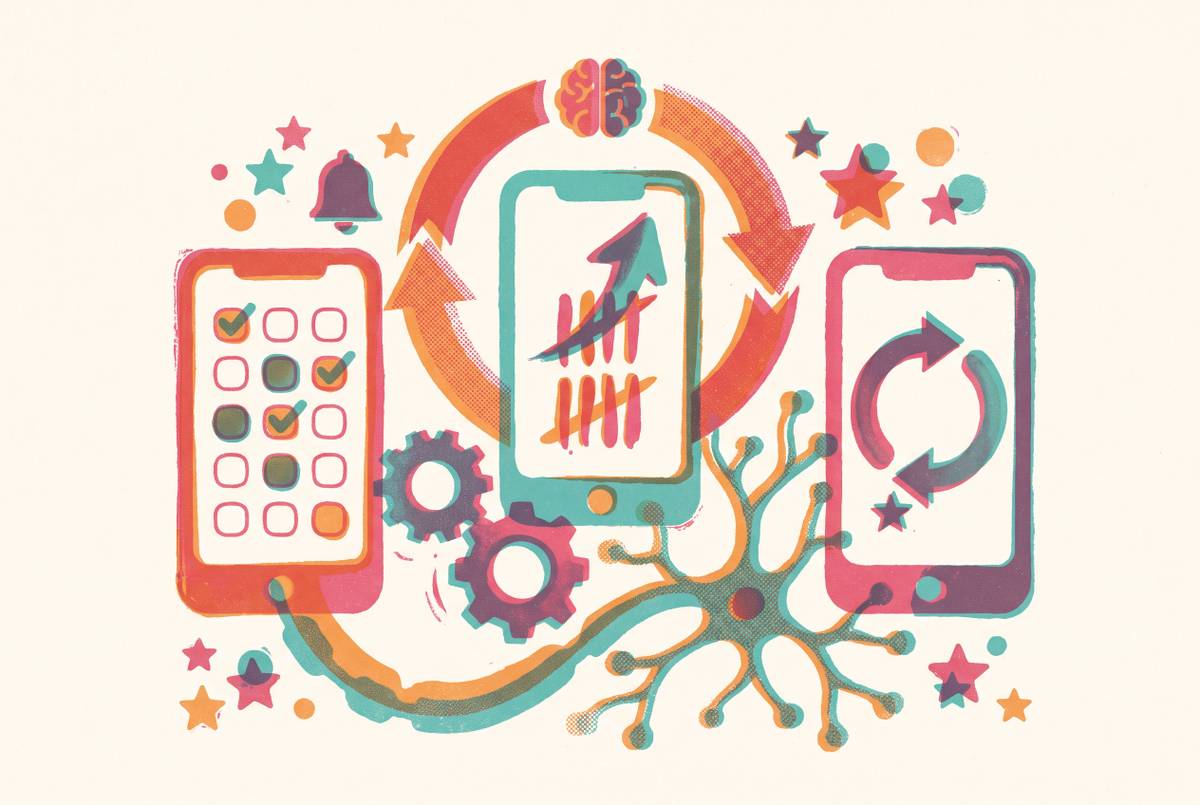
ADHD routine-building apps are most useful when they compensate for unreliable working memory. The best match depends on where the routine breaks: some apps help the user follow each step, some provide an initiation cue, and some make progress feel rewarding right away. The standard is not how much an app organizes, but how much remembering, deciding, and self-prompting it removes.
Why ADHD routines fail at the neurological level, not the effort level
Knowing exactly what needs doing and being unable to start can feel like a contradiction. The intention is there, but action does not follow. Working memory helps explain that gap. It is the brain’s temporary holding space for the information needed to execute a task, including its steps, what comes next, and the context needed to continue mid-action. When that holding space is unreliable, a person can know how a routine works and still struggle to do it.
A meta-analysis in Psychiatry Research found that dysfunctional connectivity between the frontoparietal network and the striatum may lead to inefficient working memory in children with ADHD. It also identified abnormalities in the cerebellum, which is implicated in inhibitory control. A person may struggle to hold a sequence long enough to execute it, so a routine can collapse before it begins. This is not evidence that the person does not care.
Working memory is not the whole explanation, however. Atypical dopamine signaling can also reduce the ability to generate motivation and reward for tasks without immediate stimulation. These are related but distinct obstacles. Working memory difficulties disrupt sequencing, while dopamine dysregulation can disrupt initiation and sustained motivation. A useful tool therefore needs to answer a more precise question than whether someone needs help “being productive.”
Why the willpower framing persists and why it causes real harm
From outside, an interrupted routine looks like something left undone. The lost sequence or absent initiation cue is less visible. That gap makes it easy to mistake trouble carrying out a task for a lack of effort, especially when ordinary lists, planners, and calendars seem to have everything the person needs. Yet those tools often depend on a person being able to stay focused, start on their own, and keep a plan in mind over time. They can record an intention without supplying the support needed to act on it.
When a system keeps failing them, a person may think they lack discipline instead of seeing how much it asks of their working memory. A 2026 systematic review in Frontiers in Psychiatry found that greater ADHD symptomatology correlated with more internalized stigma, which was linked to functional impairment, worse self-esteem, and poorer quality of life. Self-stigma included self-deprecating labels and ADHD devaluation. Those associations show why the emotional consequences deserve attention.
A 2025 counselling psychology research project at City University of Seattle found that shame in women with late-diagnosed ADHD appears to internalize years of external judgment, character blaming, and ostracization. Frequent reprimands and negative feedback contribute to negative self-perceptions. App design enters that same emotional context. Broken streaks and penalty mechanics risk reinforcing the judgment that another missed routine proves something about the user. The alternative is a different design premise, which is to hold what the person cannot reliably keep in mind.
What "externalizing cognitive load" actually means in practice
An externalized routine stores its structure outside the brain. It holds the sequence, marks the user’s position, and provides the next cue to act. Those functions reduce the need to reconstruct the plan while carrying it out. A reminder does something narrower by announcing that a task exists. The distinction is whether the user still has to decide what comes next and remember how far along they are.
Capture is the first point where that distinction becomes practical. If recording a thought requires several decisions, the thought may disappear before the entry is complete. Speed is part of the mechanism here. Frictionless capture compensates for unreliable working memory, guided sequencing supports planning and initiation, and reward signaling supports motivation. A useful ADHD routine tool explicitly addresses at least one of these functions rather than merely presenting information attractively.
This framework also separates a feature’s purpose from its appearance. A timer can help by supplying a transition cue, while a game element can help by making progress concrete. Neither is useful simply because it is engaging. Evaluate the feature by asking what cognitive work it takes over. That question is a better basis for comparing apps than which one has the most features.
Which apps help with ADHD working memory and step-by-step routines?
Goblin Tools addresses the point where a task is too large to become an action. Its Magic ToDo feature supplies decomposition by breaking a task into steps, with a “spiciness” dial controlling how granular those steps become. That makes it relevant when a to-do item produces paralysis because planning its parts is itself difficult. It is free on the web, with a low-cost one-time purchase on mobile.
Todoist addresses a different bottleneck, which is the effort of recording and structuring an intention before it disappears. Typing “submit report tomorrow at 3pm p1” creates a dated, prioritized task through natural language parsing. The user supplies the thought and the app handles its structure. This reduces the overhead of separate filing and scheduling decisions, although the user still supplies the priority. Its reward system gives points for tasks the user finishes, adding a small reward to capture and organization.
TickTick moves further into the structure within a task. Subtasks can turn “Write report” into “Draft intro,” “Add research,” and “Proofread,” making the sequence available outside working memory. Its built-in Pomodoro timer also supports time-blocking without a separate app. The timer tells the user when to stop and take a break. In this case, the support concerns both the order of work and the transition out of a work period.
Routinery makes the routine itself the guided experience. It turns a Morning Routine or Evening Routine into timed steps, using voice and push prompts to cue progress from start to finish. The user can follow the routine with less repeated replanning. Compared with a capture tool, its distinctive contribution is the ongoing sequencing and cueing needed during execution. These products therefore address different points in the same process, from forming an actionable step to following an established flow.
Tools that solve initiation and accountability, not just organization
When the sequence is clear, trouble starting is an initiation problem, and another layer of organization may leave it intact. Focusmate approaches the gap through virtual body doubling. Users book a video co-working session, state their goal at the start, and work with a partner for its duration.
The mechanism is a specific social contract. Someone is waiting at 2:00 PM, so beginning work has an external cue rather than depending entirely on self-generated motivation. The co-working format also provides ambient stimulation meant to keep users engaged without distracting them. The partner does not decompose the task or choose its priority. Instead, the session supplies accountability at the point where a written intention needs to become action.
Sunsama addresses initiation from the direction of overload. Its visual daily timeline warns when planned tasks exceed the daily time limit, helping constrain a plan that might otherwise become a 47-item list. Setting a limit for the day makes it easier to choose what to do. Voice-first capture can support an even smaller beginning, with “Hey Siri, remind me to...” recording a thought before it disappears. AI-powered tools can extend that support through transcription, task detection, suggested priorities, and summaries, though automating organization is not the same as supplying accountability.
Tools that use reward signaling to sustain routine over time
Starting once does not solve repetition over weeks. For ADHD brains, the reward signal from doing the same thing over and over can fade quickly, so even with a clear plan, a person may lack the motivation to keep going. Gamification responds by supplying concrete evidence of progress close to the action. Its rationale is therefore more than decoration. A reward can support the routine or compete with it for attention.
Habitica, which is free and offers purchases for those who want them, turns daily tasks into role-playing quests. Users earn in-game rewards when they complete habits and get in-game penalties when they skip them. Consequences become visible rather than distant or abstract. That playful framing is best suited to users who enjoy it and respond to external accountability. Its penalties also expose the tension discussed earlier, because a consequence that motivates one person may deepen another person’s shame.
Forest uses coin rewards and focus-session milestones that unlock tree species to provide immediate feedback. It is free on iOS and Android, with an optional Forest Plus subscription for advanced features. Its gamification and loss aversion principles address phone-driven distraction. Some ADHD users find that feedback helpful for sustaining focus, but Forest does not claim that its features are deliberately engineered around ADHD dopamine loops. A plausible behavioral mechanism is not the same as a product-specific clinical finding.
The research also leaves room for caution. A 2025 systematic review of gamification in neurofeedback training presented at the BCI 2025 conference found that game elements may enhance engagement and motivation but can introduce distraction for users with ADHD. That evidence concerns the use of game elements in neurofeedback training. It nevertheless raises a useful design question. Does the game make the intended action more rewarding, or does interacting with the game become the more compelling task?
The tool-adoption paradox and how to sidestep it
Every proposed support has an entry cost. Learning, configuring, and maintaining a system require executive function, which is exactly what the system is meant to relieve. A tool can therefore be well matched in principle and inaccessible in practice.
Differences among people with ADHD make it even harder to recommend the same approach for everyone. A 2025 review in Journal of Psychological Science found that roughly one in five children with ADHD show cognitive deficits, suggesting that only a small proportion may benefit from cognitive training. A diagnostic label alone cannot identify the function a particular user needs to externalize.
A 2026 mixed-method neurocognitive study in Neurology International identified three executive function profiles across ADHD, dyslexia, and comorbid presentations. They were globally reduced executive functioning, verbal-mnestic executive vulnerability, and selective executive control deficit. For someone choosing a tool, the practical implication is to start with the obstacle causing the most friction now, whether that is initiation, sequencing, or motivation. There is no need to solve all three at once.
Start with one tool that offers voice-first input, minimal configuration, or immediate usability on first open. Two or three complementary tools may ultimately fit better than one all-purpose system, but add a third only after the first two are stable. If setup requires more than one sitting, the tool may be asking too much of the resource it is supposed to protect. Choose the smallest usable support for the point where the routine currently breaks.
Framing routine-building as identity work, not productivity optimization
A small routine win can challenge a damaging personal story. For someone often told they lack discipline, finishing a task with support that meets their needs can show them what they are able to do. The support changes the conditions under which the person can act.
A 2025 Nature Scientific Reports study found that acceptance and enrichment, the positive dimensions of illness identity, were consistently associated with greater social participation and improved health-related quality of life. Rejection and engulfment were associated with greater distress and poorer outcomes, while emphasizing strengths was identified as a way to counter ADHD-related stigma and promote a more positive self-concept. This is a different goal from maximizing output. Small wins that come without much friction can, over time, help a person see themselves as someone who follows through. The system provides the structure, but the person deserves the credit.