Building a Post-Diagnosis Routine When You Are Starting From Zero
Executive dysfunction requires external scaffolding, not willpower.

An estimated 15.5 million adults had a current ADHD diagnosis in 2023, about 6.0% of the population, and more than half of them, 55.9%, found out as adults rather than as kids. If a diagnosis just landed on someone at 34 or 58, that person sits inside the largest, fastest-growing group carrying this label. Most of them ask the same question once the name arrives: now what actually comes first?
Why willpower-based advice fails newly diagnosed adults, and what executive dysfunction means
Between 80% and 90% of adults with ADHD deal with executive dysfunction daily, according to research on the condition. Not on bad weeks. Daily. That number should end the willpower conversation outright, because executive dysfunction is not a symptom that flares under stress. It is the baseline the rest of life gets stacked on top of. Advice built for a brain that only occasionally struggles was never going to fit one that struggles by default.
Executive function is a cluster of top-down processes, attention regulation, cognitive flexibility, inhibitory control, working memory, all leaning on roughly the same neural real estate. Research published in PMC frames it this way on purpose, because folding all of that under "focus" or "memory" undersells how many systems are actually involved. A common assumption is that ADHD is essentially a memory problem, that enough sticky notes would fix it. That framing misses the point, and it's the wrong starting point for almost everything that follows. Memory is one broken gear in a much bigger machine.
Take time blindness, a term used for the genuine difficulty perceiving time passing or estimating how long a task will take. "Just get up earlier" fails as advice for exactly this reason: it assumes a person can accurately picture how the morning will unfold, when the deficit lives in that picturing itself.
None of this is metaphorical. A 2025 systematic review covering 68 studies, published in Frontiers in Neuroscience, found a consistent upward trend in theta power on resting-state EEGs of adults with ADHD, a measurable signature that appears on the EEG regardless of what the person believes about their own discipline. It is a measurable, objective marker of the underlying neurology. Anyone still quietly blaming themselves for twenty years of missed deadlines is arguing with a brainwave pattern, and the brainwave pattern is going to win that argument every time.
If the brain cannot reliably build its own scaffolding, the scaffolding has to get built externally. That is the design issue the rest of this piece works through.
Why "starting from zero" is an advantage for building an ADHD-compatible routine
Having no system beats having a broken one, and most newly diagnosed adults assume the opposite. They assume the years spent trying and failing gave them a head start. They assumed wrong: the years spent trying and failing did not give them a head start. Adults who try to bolt a neurotypical routine onto years of half-working habits are stacking new friction on old friction: there's an existing pattern to fight, undo, and replace before the new behavior even gets a shot. Starting from zero means there's nothing to unwind first, which makes the newly diagnosed adult, oddly, better positioned than the person who's been limping along on willpower since college.
Productivity work built around ADHD means understanding how the ADHD brain actually processes tasks and motivation, then designing around that wiring instead of against it. Picking up a generic productivity book and hoping the advice translates is the single most common mistake newly diagnosed adults make, and usually only once. It fails because that advice assumes a brain that responds to discipline and repetition for their own sake. This one doesn't, and pretending otherwise wastes months.
The ADHD brain runs on a different fuel mix. Novelty, urgency, connection, and reward are widely described as the real levers that drive the ADHD brain. So the goal on day one is not a "routine" in the traditional sense.
The goal is one anchor. A single, small, reliable behavior. A second one gets added only once that first one holds, and every anchor that sticks is proof the system works. Every one that gets skipped is data about where the design needs to change, not evidence that the person failed.
The physiological foundation that has to exist before any routine can hold
Sleep comes first. Poor sleep worsens inattention, impulsivity, emotional regulation, and executive function directly and immediately, according to research on ADHD and sleep. That makes sleep closer to a precondition than a wellness add-on sitting beside the "real" work, and treating it as optional is the second big mistake this piece wants to talk someone out of.
Research puts chronic sleep issues, insomnia, delayed sleep phase, dysregulated melatonin, somewhere between 60% and 70% of adults with ADHD. The person who can't fall asleep before 1 a.m. and can't get upright before 9 is statistically typical, not broken. Research on ADHD and sleep suggests that the difficulty waking up is neurological before it's anything else, rooted in delayed circadian rhythms rather than laziness or poor discipline.
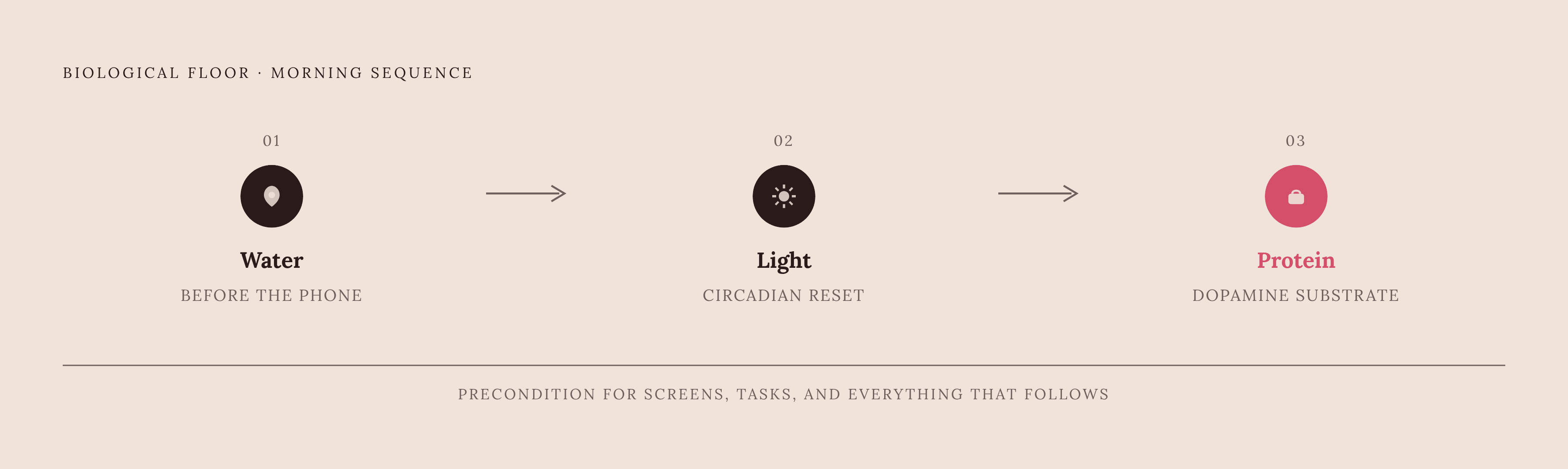
So what actually moves the needle? A specific, small sequence that recurs across ADHD-focused clinical guidance: water before the phone, light exposure within the first few minutes of waking to help recalibrate a circadian rhythm that's usually already running late, and a protein-rich breakfast instead of straight sugar or caffeine. That sequence is the biological floor the rest of the routine sits on. It belongs first, before task lists, before apps, before anything with a screen.
Once the body has something steady to organize around, the mind finally gets a stable peg to hang behavior on.
Building the first behavioral anchor without overwhelming the system
Long morning checklists are a trap for most ADHD brains, and this is where a lot of well-meaning planning goes to die. A ten-item list looks organized on paper and collapses within four days, because the sheer volume overwhelms the exact function it's supposed to support. A core principle in ADHD productivity guidance calls for brutal simplicity: a small number of non-negotiable tasks. Not five. Not a color-coded chart. Three. Nailing those three raises the odds the rest of the day holds together too.
Getting started on any one of them is a separate problem from finishing it. The two-minute rule, a technique that appears across ADHD productivity guidance, addresses that directly: the instruction to the self is simply "do this for two minutes." That framing removes the obligation to finish, and finishing was never what the ADHD brain resists. Starting is. Once the two minutes are underway, momentum tends to carry the rest on its own.
A widely recommended approach is to chunk anything bigger than a single simple action, in writing, into manageable pieces, instead of holding it loosely as an intention in someone's head. Working memory gaps mean intentions held only in the mind evaporate under the mildest distraction, so the chunk has to live somewhere outside the skull.
That points to a bigger need: an external brain. A single, reliable capture system for every task and stray thought, outside the head, is core infrastructure, not a nice-to-have. It's the offloading mechanism that keeps the anxiety of forgetting from becoming its own exhausting task on top of the original one.
One anchor, firing without drama. That's the entire target at the outset. Completeness is a later problem, and trying to solve it now is how the whole thing collapses by Thursday.
Night-before preparation as the real mechanism behind morning success
Most of what makes a morning succeed or fail gets decided the night before, not during the morning itself. A productivity company's frameworks show morning executive function capacity tending to run lower, so the smart move is doing the deciding in the evening, while capacity is still high. Anyone still trying to plan their morning at 6:45 a.m. is scheduling the hardest cognitive work for the worst possible hour.
Concretely: lay out clothes, pack the bag, decide breakfast, put keys and wallet by the door, the night before. That same guidance shows a few minutes of setup work eliminates a surprising number of small decisions that would otherwise pile up at 7 a.m. Decision fatigue compounds executive dysfunction rather than sitting quietly alongside it, so every choice made the night before is cognitive fuel saved for actually getting out the door.
A consistent theme from ADHD specialists, including those at the ADD Resource Center, is that morning routines need to externalize executive function, rather than lean on an internal regulation system that isn't reliably online first thing. Night-before prep is probably the cheapest, most powerful form of that externalization available. It costs a few minutes and nothing else, which is what makes skipping it such an easy, avoidable mistake.
It's an act of care aimed at tomorrow's version of the person doing it, someone who will wake up with less capacity than tonight's version currently has.
Behavior chaining and habit stacking: how one anchor becomes a sequence
Once a single anchor holds reliably, the next move is chaining. Frameworks from a life skills organization show behavior chaining working by letting the completion of one task trigger the next, so the sequence runs on its own cues instead of demanding a fresh decision at every step.
Habit stacking is the more familiar cousin, popularized by James Clear in Atomic Habits and building on BJ Fogg's earlier Tiny Habits research. Applied to ADHD, the principle is to attach a new behavior to something that already happens on autopilot. Take medication right after making breakfast. Stretch while the shower water heats up. Review the day's list while eating. None of that requires a fresh decision, because it rides on top of a behavior that's already automatic.
Why does this work specifically for ADHD, rather than as a generic life-hack? Each link removes a task-initiation step, and task initiation is exactly where an ADHD brain tends to stall. The cue is baked into the prior behavior, so the executive function demand that usually causes the freeze never really fires.
One rule matters most here, and it's the one most people ignore in their eagerness to fix everything at once: add a single link at a time. A two-behavior chain that holds every day beats a seven-behavior chain that collapses by Thursday. Each completed link releases a small dopamine signal, a momentum loop that rewards forward motion instead of holding out for total completion.
Environmental design and body doubling as external executive function replacements
The environment is not a neutral backdrop for an ADHD brain. The environment functions as an active participant: shaping physical and digital surroundings on purpose removes distraction and plants cues that trigger the right behavior without asking memory to do the work.
A water glass left on the counter is a prompt that costs nothing to follow. A phone left in another room removes an entire decision from the morning instead of demanding willpower to resist checking it. These are memory substitutes built into physical space instead of stored in the head, and that distinction is the whole point.
Body doubling deserves attention because the mechanism is genuinely strange until it's been seen working. A psychiatry practice notes that doing a task in the presence of another person, even one doing something unrelated, provides structure and accountability. The other person doesn't need to help. They don't need to be working on anything related. Their presence alone appears to be the active ingredient, and that alone says something about how much of ADHD's daily struggle is about regulation rather than information or effort.
A few explanations appear across the clinical literature for why this works. Gentle social pressure raises the cost of drifting off task. A kind of co-regulation lets the ADHD brain borrow calm and focus from someone nearby. The novelty of a social setting raises dopamine and attention on its own.
Movement belongs in this conversation too, and not as an aside. A treatment center describes physical activity as a prerequisite for focus rather than a distraction from it, fueling the same brain systems responsible for attention, motivation, and emotional regulation. Environmental design, body doubling, and movement are infrastructure doing a job that internal executive function can't reliably do alone. None of it is willpower dressed up in nicer language, and treating it that way leads people to blame themselves for a systems failure instead of fixing the systems.
Using timers, artificial urgency, and gamified rewards to maintain momentum
Work expands to fill the time it's given, the old Parkinson's Law problem, and for ADHD brains that crave urgency to begin with, shrinking the available time on purpose can sharpen focus rather than trigger panic. Clinicians writing for a publication focused on the condition explain that dopamine spikes when urgency rises, which makes artificial urgency a real neurochemical lever rather than a productivity trick borrowed from a corporate seminar.
A version of the Pomodoro method adapted for ADHD, described by one outlet covering the condition, uses defined focus intervals with built-in breaks to keep attention sharp and stop hyperfocus from swallowing the rest of the day. Whether the interval runs 25 minutes or 40 matters less than the simple fact that a hard limit exists.
Gamification runs on that same neurochemical logic rather than sitting off to the side as a gimmick for people who like video games. XP systems, milestone tracking, small reward loops: they tap the identical dopamine feedback mechanism that makes urgency and body doubling effective. The brain needs that signal at intervals, not once at the finish line, or it checks out long before the task gets done. That's the actual design flaw in reward systems that only pay out on full completion. An ADHD brain given no signal until the very end disengages somewhere in the middle, nearly every time.
Some newer tools built around this need lean on voice instead of typing or forms as the input method, using natural conversation to capture tasks, break them into milestones, and hand out small game-style rewards along the way. That's not a stylistic flourish. Typing into a form is its own small executive function demand, and for a lot of ADHD users, that demand is precisely the friction point where the habit dies before it forms. It's a design requirement.
How to know when an anchor is holding and when to expand the routine
A new anchor gets added only once the current one fires without deliberate effort. That's the whole rule, and it has less to do with time elapsed than with the quality of the behavior itself. A week of gritted-teeth execution is not a week of automatic behavior, even if the calendar looks identical from the outside.
What does a held anchor actually feel like? The behavior happens before there's been a conscious decision to do it. Skipping it feels wrong, almost uncomfortable, rather than a relief. No timer had to fire, no sticky note had to catch the eye, no reminder had to buzz.
The single most common way these routines fall apart is optimism arriving at exactly the wrong moment. Someone strings together five solid days and, feeling capable again, bolts on three new behaviors at once. The system, still fragile underneath that early success, buckles under the extra weight almost immediately. That instinct to add more the moment things start working runs directly against what the data from those five days is actually saying.
A skipped day is data, and figuring out which specific link in the chain broke, and why, matters more than feeling bad about the miss. Maybe the night-before prep didn't happen. Maybe the reward loop went quiet for a few days. Either way, that's a design problem with a design answer.
Small, consistent wins compound into something that looks, from a distance, like discipline. It was never discipline in the way the term usually gets thrown around. Willpower was never going to override a nervous system running on measurably different EEG patterns and biology nobody chose. What works is structure, built in layers, each one tested before the next gets added. Every anchor that holds is permanent ground gained, not a temporary fix waiting to fail on some Thursday down the line.