Why ADHD Is Missed Until Adulthood
Girls' quieter symptoms and masking strategies delay diagnosis into adulthood.
In 2023, roughly 15.5 million adults in a large national population carried an ADHD diagnosis, and 55.9% of them heard those words for the first time as adults, not as kids. Globally, the estimate for symptomatic adult ADHD runs past 404 million people. That's the puzzle at the center of this piece: a massive gap between how many adults live with the condition and how many are ever told what it is. And that gap doesn't stay empty. Left unnamed, it fills with something else, often anxiety or depression: about 80% of adults with ADHD carry at least one co-occurring psychiatric diagnosis.
So why does a neurological condition, one that shows up in early childhood by definition, take thirty or forty years to get correctly named in so many people? The answer is a stack of failures, starting with the very first draft of what ADHD was supposed to look like. It's a stack of them, starting with the very first draft of what ADHD was supposed to look like.
What ADHD was originally defined to look like, and who that definition centered
The diagnostic picture of ADHD didn't emerge from a broad survey of how attention difficulties show up across different people. It emerged from observing the loudest, most disruptive kids in the room, and those kids were overwhelmingly boys. A child who couldn't sit still, who blurted out answers, who got sent to the principal's office, was the one referred for evaluation. That child became the template, and the diagnostic criteria still carry his fingerprints.
Consider the age-12 rule: current criteria require that symptoms be present before age 12, which sounds reasonable until you ask how that evidence is supposed to appear in an adult evaluation decades later. An adult walking into an evaluation has to reconstruct, often from memory alone, what their attention and behavior looked like in elementary school. If no teacher flagged it, if no parent kept report cards noting "doesn't apply herself," there's no paper trail. The diagnostic system assumes a visible, disruptive childhood presentation generated some kind of institutional record. For the quieter presentations, that record often never existed in the first place.
This structural bottleneck produces every other constraint in this piece, and the sentences that follow, showing how the classic presentation triggers a referral while quieter symptom profiles don't, demonstrate it. The classic presentation, impulsive, hyperactive, conduct-disrupting, is what triggers a referral. Quieter symptom profiles simply don't generate the same institutional response, and a diagnostic framework built around one presentation will always struggle to catch the others.
Why inattentive ADHD hides in plain sight throughout childhood
Inattentive-type ADHD doesn't interrupt class. It doesn't get anyone sent to the hallway. It looks like daydreaming, like a messy backpack, like a kid who "just needs to focus more." Adults around that child, understandably, read those patterns as personality rather than neurology. Nobody refers a daydreamer for evaluation the way they refer a kid who flips a desk.
One clue about how selective this recognition really is comes from research on which kids get flagged even when their symptoms are just as severe. Children with stronger prosocial skills, or higher cognitive ability, were less likely to be recognized as having ADHD, even with clear symptoms present. In other words, being likable or being smart can actively mask the condition from the adults meant to notice it. A kid who's pleasant and articulate gets the benefit of the doubt that a disruptive kid never receives, and that benefit of the doubt delays or erases a diagnosis entirely.
Emotional dysregulation offers another angle on this same selectivity. In that same research, emotional dysregulation was strongly linked to recognized ADHD in boys, but not in girls. The same behavioral signal, present in both, only counted as diagnostic evidence in one gender. Research has noted that inattentive symptoms in women are less likely to lead to referral and diagnosis. The pattern isn't subtle once you see it: recognition depends less on what symptoms are present than on whose body is displaying them.
How masking turns ADHD into an invisible internal experience, especially for girls
Masking is the act, conscious or not, of hiding symptoms well enough to appear organized, calm, or competent. It's a survival strategy, not deliberate deception, and it works precisely because it's invisible, which is also what makes it so damaging over time. It's a survival strategy, and it works precisely because it's invisible, which is also what makes it so damaging over time.
Girls are socialized early toward compliance and self-control, and that socialization becomes scaffolding for the mask. Sitting quietly while the mind wanders. Copying a peer's color-coded binder system without understanding why it works for them and not for you. Overperforming socially to compensate for what feels, internally, like constant chaos. None of this appears as ADHD to an outside observer. It shows up as a well-behaved kid who's a little scattered sometimes.
Research has found that this masking begins early, in the preteen years, well before adolescence is in full swing. That's a striking detail: the coping strategy predates the identity formation typically associated with the teenage years. Kids are already learning to hide a core part of how their brain works before they've even settled into who they are.
The same research ties masking, or camouflaging, to worse mental health outcomes: higher camouflaging predicted poorer psychological wellbeing overall. The mask isn't free. Every hour spent performing organization that isn't natural is an hour of cognitive load nobody else can see, and the bill for that comes due eventually, usually in the form of exhaustion, anxiety, or a creeping sense that something is wrong that can't quite be named.
The gender diagnosis gap in concrete terms, and what hormonal shifts across the lifespan add to it
Boys are diagnosed at roughly double the rate of girls, around 15% versus 8%, a substantial skew. That's not a small skew. And the gap doesn't close once girls become women navigating the healthcare system as adults. Research has found women experience a diagnostic delay of nearly four years compared to men, even among those who had engaged with the healthcare system.
That last detail matters enormously. This isn't a case of women avoiding care. They're in the system, sitting across from clinicians, describing symptoms. Something in that interaction, whether it's which symptoms get asked about, which ones get volunteered, or which ones get weighted as significant, is steering the conversation away from ADHD and toward something else. Often anxiety. Often depression. Sometimes both, layered on top of an ADHD that never gets named because the anxiety and depression are treated as the whole story rather than downstream consequences.
Hormonal biology layers onto this, making the picture more complicated still. Emerging research suggests that hormonal shifts across the lifespan, including perimenopause and menopause, may influence ADHD symptoms and the vulnerabilities tied to them. How many women are told their brain fog and disorganization in their 40s and 50s are simply "menopause," when a preexisting, unnamed ADHD is interacting with a hormonal shift to make symptoms sharper than they've ever been?
How race and socioeconomic position shape who gets diagnosed, and who gets labeled something else
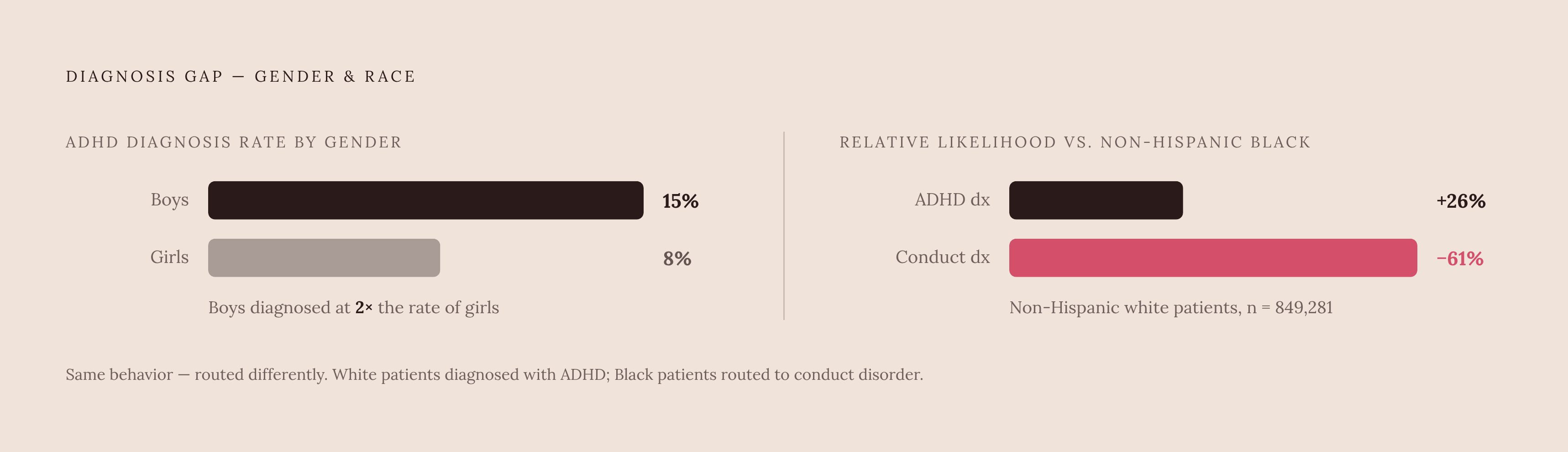
Gender isn't the only axis this bias runs along. Black and Hispanic children are diagnosed with ADHD at lower rates than their white peers and are more likely, when they display the same behaviors, to be diagnosed with oppositional defiant disorder or disruptive behavior disorder instead. Same behavior. Different label. And that different label carries a completely different set of institutional responses, one framed around support, the other framed around discipline.
In a cohort of 849,281 ADHD patients, non-Hispanic white individuals were about 26% more likely to receive an ADHD diagnosis, and about 61% less likely to be diagnosed with conduct disorder, compared to others, and these numbers are stark. In a cohort of 849,281 ADHD patients, non-Hispanic white individuals were about 26% more likely to receive an ADHD diagnosis, and about 61% less likely to be diagnosed with conduct disorder, compared to non-Hispanic Black individuals. The mean age of ADHD diagnosis was over eight years older for white patients than for Black patients in that same cohort, with a disproportionate share of white patients diagnosed in adulthood.
What explains a gap this specific? One documented mechanism is adultification bias: the tendency to perceive Black children as more adult-like and less innocent than their white peers at the same age. The same fidgeting, the same inattention, the same impulsivity that reads as "needs support" in a white child reads as "being defiant" in a Black child. The interpretation of identical behavior shifts depending on who's exhibiting it, rather than the underlying neurology differing, and that shift in interpretation determines which door a kid gets sent through: the one marked evaluation, o... It's that the interpretation of identical behavior shifts depending on who's exhibiting it, and that shift in interpretation determines which door a kid gets sent through: the one marked evaluation, or the one marked discipline.
What decades of unrecognized ADHD costs, in work, in mental health, in daily functioning
None of this is abstract once it plays out over a career and a lifetime. Adults with ADHD report an average of 21.6 more days of lost work productivity a year, largely through presenteeism: showing up, sitting at a desk, and still not being able to produce. It's executive dysfunction and burnout compounding on each other, day after day, in a workplace that has no idea what it's looking at, not a motivation problem. It's executive dysfunction and burnout compounding on each other, day after day, in a workplace that has no idea what it's looking at.
Longitudinal research shows severe, unmanaged ADHD symptoms can lead to as much as 75% lower net worth at retirement. It's not a one-time cost, it's the compounded result of missed opportunities, financial disorganization, and career setbacks accumulating year over year, invisible until the moment someone runs the numbers on a retirement account and finds a fraction of what a career should have produced. At a societal level, the price tag for adult ADHD in that same country. runs past $122 billion annually, driven by lost productivity, absenteeism, and higher healthcare use.
The mental health cost sits right alongside the financial one. Data shows 51.2% of health center visits by adults with ADHD included an anxiety co-diagnosis, and 48.8% included a mood disorder. They're what accumulates when a person spends decades attributing a neurological difference to a character flaw, trying harder each year, and failing in ways that feel, from the inside, entirely personal, and these are not coincidental overlaps. They're what accumulates when a person spends decades attributing a neurological difference to a character flaw, trying harder each year, and failing in ways that feel, from the inside, entirely personal.
Why adult diagnosis feels like relief rather than label, and what it means to finally have language for a lifetime of struggle
Given everything above, it makes sense that a diagnosis landing at 35, or 45, doesn't register as bad news to most people who receive it. It reframes decades of what felt like personal failure as a structural mismatch: a particular kind of brain operating inside environments, schools, offices, families, that were never built with it in mind. That reframe doesn't erase the years already spent struggling, but it changes what those years mean.
Consider the shame that accumulates under the alternative story: being told, over and over, to try harder, to pay attention, to get organized, without anyone ever explaining that the underlying wiring made those instructions nearly impossible to follow through on consistently. Women in particular commonly report decreased self-esteem tied to ADHD, which tracks exactly with what you'd expect from years of believing a neurological difference was a defect of character.
The trend lines suggest this reframe is reaching more people. New ADHD diagnoses among adults rose from 2020 to 2023, reversing a prior downward trend, a shift researchers link to greater awareness, reduced stigma, and possibly the way pandemic conditions exposed executive function struggles that had been masked for years by external structure, like offices and commutes and in-person school, that suddenly disappeared. When the scaffolding is taken away, what's underneath becomes a lot harder to ignore.
How to build daily structure that works with an ADHD brain, starting from where most adults with late diagnoses are
A diagnosis explains the pattern. It doesn't, by itself, fix the Tuesday afternoon where a load of laundry sits half-folded and an email sits half-written. The daily mechanism behind most of the consequences described above is executive dysfunction, and it occurs in a few concrete, nameable ways: time blindness, where "later" and "never" feel functionally identical until a deadline turns into an emergency; task paralysis, where a person can want to start something and simply not be able to; and working memory gaps, where an instruction given thirty seconds ago has already evaporated.
Task paralysis in particular deserves a clear line drawn under it, because it gets confused with laziness constantly, and that confusion is corrosive. Paralysis comes wrapped in frustration and shame. The person experiencing it usually wants very badly to start. Laziness doesn't feel like that from the inside. This is a neurological block, not a motivational one, and treating it as the latter just adds another layer of shame on top of a brain that's already struggling.
A handful of strategies, drawn from clinical and coaching sources focused on this condition, target this mechanism directly rather than asking for more willpower. The Five-Minute Rule lowers the threshold for starting: commit to five minutes only, then reassess, since the hardest part of most tasks is the initiation, not the execution. Breaking tasks into genuinely small pieces helps for the same reason: "clean the room" is a wall, but "clear one surface" is a door. Limiting daily scope to no more than three must-do items, and keeping work, home, and health domains separate rather than letting them compete for the same mental bandwidth, cuts down on the overwhelm that triggers paralysis in the first place.
Body doubling, working alongside another person, whether in the same room or over a video call, gives the brain external accountability it struggles to generate internally, and it's a strategy increasingly recognized in clinical guidance around adult ADHD. Structured procrastination, meanwhile, is almost counterintuitive: instead of forcing focus on the one task causing the block, switching to a different task on the list keeps momentum going and breaks the paralysis without requiring the brain to overcome it head-on.
Friction itself is often the final barrier. For a brain already fighting time blindness and task paralysis, the extra steps of opening an app, typing out a note, or navigating through menus can be enough to kill a task before it starts. Tools built around lower-friction entry points, ones that meet a person where their attention already is instead of demanding a full sequence of steps before any progress happens, line up structurally with how executive dysfunction actually behaves. That's not a small design detail. For a brain that loses the thread in the time it takes to unlock a phone, it's often the entire difference between a task getting done and a task disappearing into the same fog that's been swallowing tasks for years.
Sources
- Products - Data Briefs - Number 543 - December 2025
- Why Do So Many Young People Miss an ADHD Diagnosis? Insights from a New Study
- ADHD in Adults (18+) 2026 | Mental Health Stats
- The Rise of Adult ADHD: 50+ Key Statistics for 2026 | Huntington Psych
- ADHD Statistics (2025): Adults & Youth – U.S. Prevalence, Treatment & Impact — South Denver Therapy
- acamh.onlinelibrary.wiley.com
- ncbi.nlm.nih.gov