ADHD Masking in Women and Socialization Differences
Girls learn to hide ADHD symptoms to fit social expectations, making diagnosis nearly impossible.

The standard explanation for why so many women reach adulthood with undiagnosed ADHD says that girls simply present with milder, less visible symptoms than boys. That account is incomplete, and the gap it tries to explain is well documented: research on adult ADHD diagnostic patterns shows women are diagnosed years later than men on average, a pattern that holds across multiple health databases. A condition with a known biological basis produces very different diagnostic timelines depending on the sex of the patient.
Part of the answer sits in how the diagnostic tools themselves were constructed. In the DSM-5 field trials, roughly one in five participants were girls, so the symptom criteria clinicians still use today were calibrated overwhelmingly against male presentation. Research at King's College London complicates the "milder symptoms" story further: girls with ADHD experience all the core symptoms boys do, but those symptoms take different forms. Hyperactivity appears as excessive talking and heightened energy rather than running or climbing, and diagnostic criteria emphasize the internalized experience of the condition over what an observer can actually see.
This changes the question the rest of this piece sets out to answer. Instead of asking whether girls have less severe ADHD, this piece asks what converts a difference in presentation into a near-total invisibility. Symptom variation alone cannot produce diagnostic gaps measured in years. Something has to actively suppress the signal, and that something is socialization: the environment girls grow up in actively discourages the visible expression of ADHD traits, long before any clinician ever evaluates them. The symptom picture is the surface that socialization produces, and understanding that mechanism is the task of everything that follows.
How gendered socialization creates the conditions for masking
Masking describes a well-documented psychological mechanism, not a personality quirk or a conscious lifestyle choice. Recent doctoral research defines it as intentionally or unintentionally concealing aspects of oneself that are negatively evaluated or stigmatized by others, a process that can involve disconnecting from and suppressing the authentic self in order to avoid stigma and preserve relationships. For women with ADHD, this definition describes a daily operating mode.
The reason masking lands so specifically on girls traces back to what they're taught to value from early childhood. Girls are socialized toward being quiet, emotionally contained, organized, and compliant, and every one of those traits sits in direct conflict with how ADHD tends to express itself: impulsivity, restlessness, disorganization, emotional intensity. Boys who violate behavioral expectations by running, interrupting, or disrupting a classroom get labeled disruptive. Girls who do the same get labeled disruptive and also face a second penalty, for failing to perform femininity correctly. That second penalty is not a minor addition. It compounds the pressure to conceal, because the girl is no longer negotiating one set of expectations but two, and the social cost of failure is higher on both counts than it would be for a boy exhibiting identical behavior.
Qualitative research published in 2025 by Bradley and colleagues names gendered challenges directly as a barrier to support for women with ADHD, describing language that reinforces harmful and stigmatized views of the condition specifically as it applies to women. Societal expectations around how women should behave run through their findings as a persistent theme, distinct from stigma itself but reinforcing it at every turn.
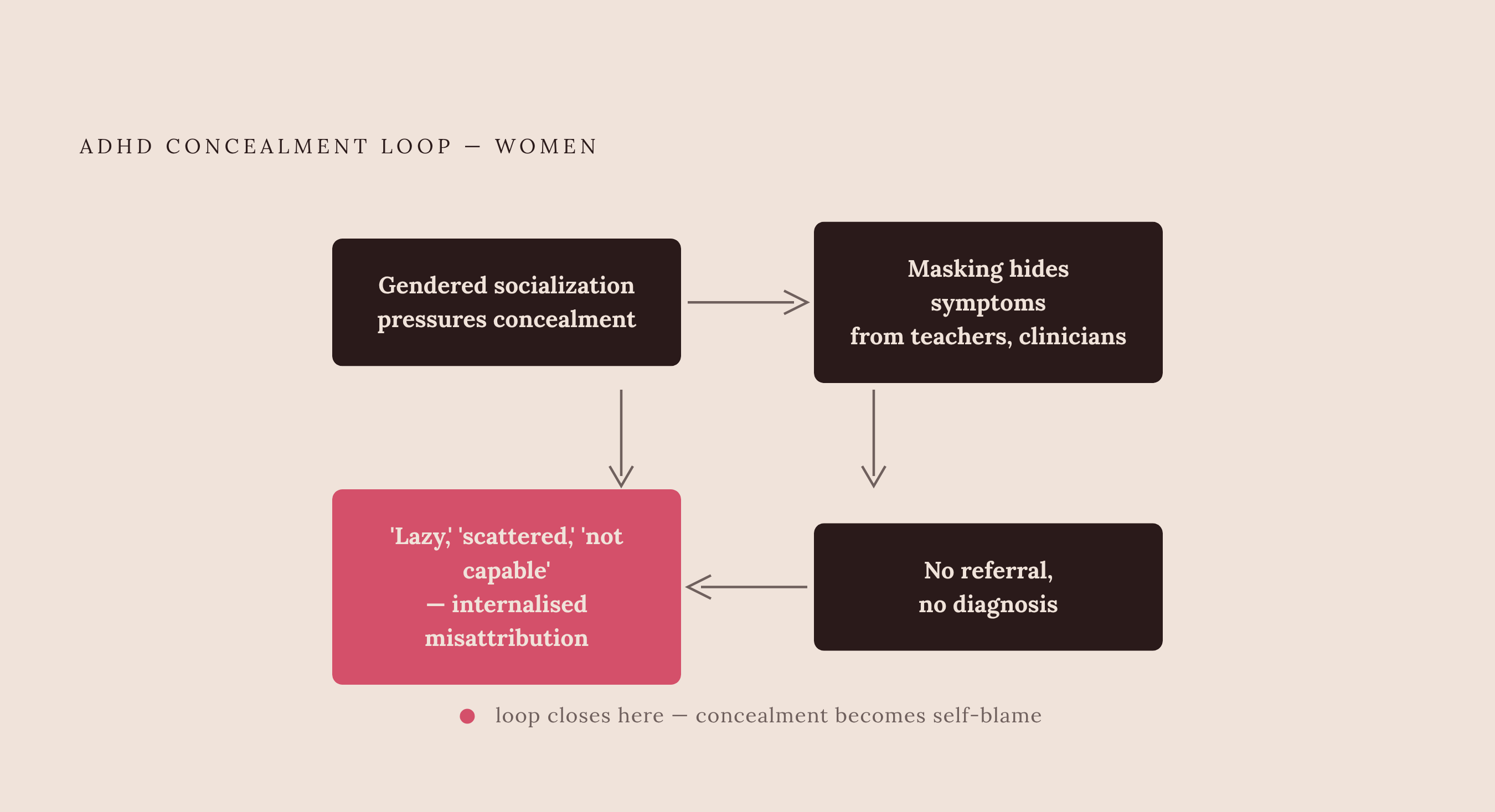
What results is a loop that closes on itself with disturbing efficiency. The more successfully a girl learns to mask her symptoms, the more invisible her ADHD becomes, first to teachers who might otherwise flag a referral, then to parents who might otherwise seek an evaluation, then to clinicians who rely on visible behavioral markers to make a diagnosis. Eventually the loop closes on the girl herself, who has spent so many years performing composure that she no longer has reliable access to what her unmasked experience would even look like. One might argue that masking isn't unique to women with ADHD, and that's a fair objection: people across genders conceal traits that draw social penalty. The specific traits targeted for concealment, and the intensity of the socialization pressure driving that concealment, are demonstrably gendered in ways the research keeps documenting. The loop described here is the structural insight the rest of this piece depends on, because the shame that accumulates later and the diagnostic blind spots documented next are both downstream consequences of this same closing circuit.
Masking and its diagnostic signatures
If masking operates as described, it should leave a measurable fingerprint on clinical assessment, and it does. A 2025 study by Platania and colleagues, using the DIVA-5 diagnostic interview with a sample of 2,257 adult patients diagnosed with ADHD at mental health clinics in the Netherlands, found a clear split in which symptom examples different patients endorsed. Childhood examples built around overt behavior, such as "always running around where it is inappropriate," were endorsed at higher rates by men. Adult examples capturing more internalized behavior, such as stepping over one's own boundaries or fiddling with hair or biting nails, were endorsed more frequently by women.
That split deserves more scrutiny than a simple note that symptoms differ by gender. It reveals a structural mismatch between what a widely used diagnostic instrument was built to detect and what ADHD has actually come to look like in women who have spent years learning to suppress its most visible expressions. A tool calibrated around running and climbing will miss a woman whose equivalent restlessness expresses itself as compulsive hair-fiddling or chronic overcommitment to other people's needs at the expense of her own limits.
Executive function research adds another layer to this picture. A 2025 review by Kooij and colleagues in Frontiers found that boys and men with ADHD tend to show worse response inhibition, slower processing speed, and more pronounced motor functioning deficits, the exact traits most legible to an outside observer. Women, by contrast, tend to show challenges concentrated in vocabulary, intellectual abilities, visuo-spatial reasoning, and arousal or speed of processing, none of which announce themselves the way a child running through a classroom does.
Taken together, these findings make the clinical encounter itself a site of systematic undercounting. A woman who has masked effectively for twenty or thirty years walks into an evaluation built to detect hyperactivity, and the clinician looking for it finds none, even though her inattention, emotional dysregulation, and executive dysfunction may be severe. The tool was never built to see what she has.
How hormonal changes across the lifespan intensify masking
Masking takes continuous effort, and that effort is not immune to biology. Hormonal fluctuation across the menstrual cycle and at menopause can intensify ADHD symptoms in ways masking was never built to absorb, which widens the gap between what a woman experiences internally and what she can still manage to perform outwardly.
Research reported in the 2025 Frontiers review found increased hyperactivity and impulsivity during the early follicular and luteal phases of the menstrual cycle in a neurotypical sample, an effect that appeared specifically in women with high trait impulsivity. The implication carries forward reasonably: if hormonal shifts intensify impulsive traits in people without ADHD, the same shifts plausibly exacerbate ADHD characteristics more sharply in women who already carry the underlying predisposition.
Menopause produces a comparable intensification. Women in one UK study reported worsening ADHD traits during this transition and described having limited evidence-based research available to help them understand what was happening to their own minds. That absence of a framework compounds the problem directly. A woman who has spent decades concealing her symptoms suddenly finds that hormonal amplification is pushing those symptoms past the threshold her coping strategies were ever designed to manage, and she has no explanation ready for why the system that worked for thirty years has abruptly stopped working.
This is often the point where diagnosis finally arrives, because the gap between internal experience and external performance has become impossible to close through masking alone. The timing of so many adult diagnoses, clustering around major hormonal transitions, makes far more sense once the biological amplifier is understood as acting on a mechanism that was already straining under decades of concealment.
The shame that accumulates before a diagnosis arrives
Every mechanism described so far, the socialization pressure, the diagnostic blind spots, the hormonal intensification, converges on a human cost that the clinical literature is only beginning to name directly: shame. A 2025 counselling psychology study at City University of Seattle found that shame experiences were prevalent throughout the developmental histories of women with late-diagnosed ADHD, describing chronic shame as a source of isolation and distress that infiltrates multiple domains of life at once, relationships, work, parenting, and private self-regard.
That shame follows directly from the misattribution produced by the mechanisms the earlier sections establish. Without a diagnosis to explain what is happening, a woman spends years attributing her struggles to character. She tells herself she is lazy, or scattered, or simply not as capable as the people around her who seem to manage life without visible strain. The masking behavior that was meant to protect her from judgment becomes, over time, the very thing that locks that misattribution into place, because the better she hides the cause, the more plausible the false explanation becomes to her and to everyone around her.
Research by Platania and colleagues identifies self-confidence as the single largest gender difference across ADHD impairment categories, with women reporting consistently higher levels of impairment in self-confidence than men. That finding lines up with a broader theory running through this research: ADHD traits conflict specifically with societal expectations placed on femininity, so the impairment a woman feels in her own sense of capability is not incidental but a direct product of that conflict. The shame women carry into a late diagnosis is the accumulated internalization of years of external judgment, delivered to someone whose neurology was never named, understood, or given a chance to be accommodated. That distinction matters enormously for how clinicians, family members, and women themselves ought to interpret the distress that so often precedes a diagnosis.
Why a diagnosis changes more than the medical record
An adult ADHD diagnosis does something a pediatric diagnosis rarely has to do: it has to retroactively explain an entire life already lived under a false theory of the self. That reframing carries its own therapeutic weight, separate from any medication or treatment plan that might follow it.
Qualitative research published in 2025 by Bradley and colleagues found that receiving an ADHD diagnosis could be, in the words of the women studied, "massive" for identity sense-making, one of four major themes the researchers identified across their interviews. Before diagnosis, many of these women describe a life spent feeling fundamentally flawed. After diagnosis, the explanation shifts from something wrong with the person to something mismatched between a particular brain and an environment built around neurotypical assumptions. That is not a small semantic shift. It relocates the source of years of struggle from character to context, and it does so with retroactive force, reaching back across decades of memory and reinterpreting them.
That reframing also tends to activate something practical: self-advocacy. Once a woman understands her ADHD as a cognitive difference, she gains the standing to seek accommodations at work, communicate her needs to partners and family, and stop spending enormous energy maintaining a mask that was never sustainable. None of this means diagnosis resolves the underlying condition or erases the years of accumulated shame in one motion. What it does is replace a false explanatory framework with a true one, which is the precondition for every practical intervention that follows. Diagnosis does not finish the work. It makes the rest of the work possible.
Support structures that work with the ADHD brain
Once the socialization-masking loop is understood, the obvious next question is what kind of support actually interrupts it rather than asking the woman to keep adapting herself to an environment that was never built for her brain. Generic productivity advice fails here for a specific, identifiable reason: instructions like "just try harder," "stay organized," or "make a list" demand that the ADHD brain perform a function it is not wired to sustain without external scaffolding, and that demand is structurally identical to what masking already asks of it. Telling a masked woman to simply exert more willpower adds a second layer of unsustainable effort on top of the first.
Task paralysis, the experience of staring at a task and being unable to start it despite knowing what needs to happen, is not a failure of willpower. It traces to a neurochemical cause: the ADHD brain's dysregulated dopamine system fails to generate adequate reward signals for low-stimulation tasks, so the internal motivation that neurotypical brains draw on simply is not available in the same supply. Structure and external cues have to supply what the internal system cannot produce on its own.
Breaking a large task into its smallest actionable components addresses this directly. Each small step becomes a reachable point of completion, giving the dopamine system something to register as a win along the way as well as at the end. That kind of decomposition functions as a core intervention targeting executive dysfunction, not a mere organizational convenience.
External structure does further work by reducing the load on working memory itself. Visual checklists, environments prepared in advance (clothes laid out the night before, breakfast items set out ahead of time), and habit stacking, attaching a new behavior to an already-automatic one, all offload planning demands that executive dysfunction makes disproportionately costly to carry internally. None of these are workarounds for a weaker brain. They are accommodations for a brain that processes reward and structure differently.
Gamification fits into this picture as something more substantive than a gimmick. When someone with ADHD receives immediate feedback, points, visible progress, a clear sense of having won something, the brain releases dopamine in a way that simply finishing a task rarely produces on its own. Tools built around that feedback loop are responding to an actual neurochemical mechanism, not dressing up a to-do list in decoration. Voice-first interaction addresses a related but distinct friction point: for a mind where thought moves faster than typing, and where the gap between having an intention and executing it is exactly where so many tasks quietly die, capturing an idea by speaking it bypasses several of the executive function hurdles involved in organizing, typing, and initiating. Each of these interventions shares a single premise: the ADHD brain is a differently structured system that functions well once the environment around it is built to match how it actually works, rather than how three generations of socialization insisted it should look instead.
Sources
- Understanding and harnessing differences in women with ADHD: A qualitative study - Sarah Bradley, Izabela Parzych, Jessica Platts, Lauren Powell, 2025
- Behind Her Eyes: Masking in Women with ADHD
- Research advances and future directions in female ADHD
- Frontiers
- ADHD in Girls and Women: The Significance of Subjective Perceptions, Inner Experiences, Context-Specific Symptoms, and Masking. - King's College London
- Sex differences in children and adolescents with attention-deficit/hyperactivity disorder: a literature review