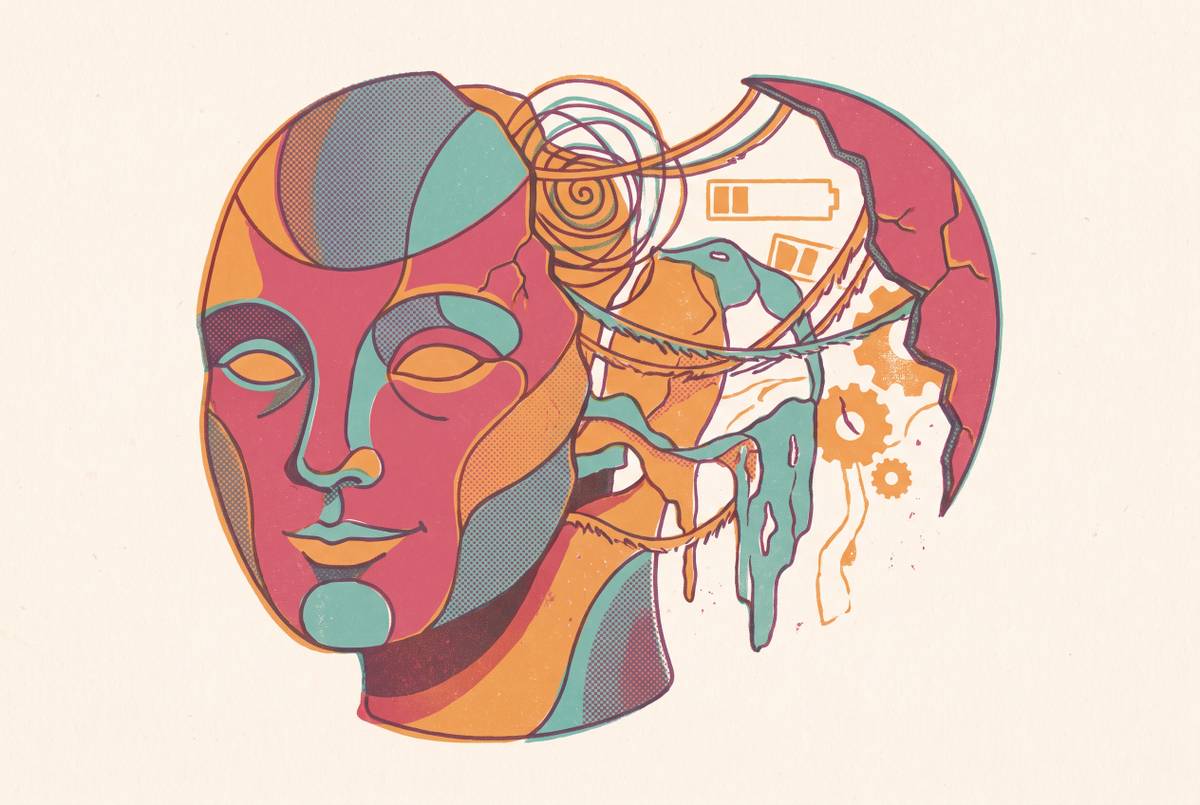
ADHD Masking Behaviors in Professional Settings
Unmasking ADHD at work costs the executive resources needed to do the job itself.

ADHD masking in professional settings is a near-automatic, continuous cognitive performance that most ADHD adults run every working day, not a coping tactic someone switches on before a hard meeting and off afterward, and it draws on the exact executive resources their brains are least equipped to spare. This piece lays out what masking is, why it costs what it costs, what that cost does to a career over time, how stigma changes its intensity, and what conditions make unmasking possible.
Masking and Why It Is Almost Universal Among ADHD Professionals
Masking, sometimes called camouflaging or social camouflage, is the conscious, sustained effort to monitor, control, and alter natural behaviors, thoughts, and emotional responses so they read as neurotypical to the people watching. That definition matters because it separates masking from something much smaller and more benign: ordinary social politeness, the kind of filtering everyone does before speaking in a meeting. Masking is not that. The distinction is the whole argument. One is etiquette. The other is a survival strategy built on the anticipation of harm.
How common is it? A 2026 Simon Fraser University study surveyed 202 people in British Columbia aged 16 or older, all of whom reported an ADHD diagnosis from a pediatrician, medical doctor, psychologist, or psychiatrist. More than 91% of them reported masking in social situations, including at work. A figure that high does not describe an edge case or a subgroup with unusually severe symptoms. It describes a near-universal feature of what it means to hold a job while managing ADHD.
What does masking look like in practice? SFU participants named specific, granular behaviors. Nodding along and murmuring "yeah, mm-hmm" through a meeting while attention has drifted elsewhere, or has narrowed entirely onto the performance of appearing attentive. Suppressing the urge to fidget, to get up, to interrupt with a thought before it disappears. Rehearsing what to say before a conversation even starts, then tracking facial expression, tone, and posture throughout it in real time. Holding back an unconventional idea, not because it is wrong, but out of fear it will read as unprofessional or strange. A behavior SFU researchers grouped under "compensation" runs through all of it: overpreparing, overworking, redoing tasks quietly behind the scenes to offset any visible trace of an ADHD trait before a colleague ever has the chance to notice one.
Why does this concentrate so heavily at work specifically? Career progression sharpens the stakes further: the fear of being seen as "not promotable" pushes people to over-correct in exactly the areas where ADHD traits might show. And the shift toward digital, remote-first work has not made this easier. Sustained attention, executive control, and rapid context-switching are the core demands of digital work and the core areas where ADHD produces impairment. The format of modern work and the shape of the condition line up almost perfectly, and not in the ADHD professional's favor.
What ties all of this together is that masking is built to be unseen. Its entire function is to make an ADHD trait disappear from view before a manager or colleague registers it. Which means the very success of the performance, the thing that makes it effective, is also what keeps its cost invisible to the people setting deadlines, running meetings, and writing performance reviews. Almost nobody signing the paycheck knows it is being paid.
What Drains the Cognitive Resources ADHD Brains Can Least Afford to Lose
Calling masking "tiring" undersells what it actually does. It is not a general drain comparable to a long day of meetings, it is a specific draw on working memory, attention regulation, and behavioral inhibition, the precise executive functions that ADHD already compromises. Paying a tax in a currency you are short on hits differently than paying it in a currency you have plenty of, and that is the mechanism at the center of this entire subject.
Executive functions are the neurocognitive skills that let a person plan, sustain attention, work toward a goal, monitor their own behavior, and regulate impulse and emotion. Under the unifying theory of ADHD, impairment clusters across four domains: working memory, internalized speech, the regulation of emotion, motivation, and arousal, and reconstitution, the capacity to break behavior down and recombine it flexibly in response to a situation. These are not small inconveniences that make a Tuesday slightly harder. They form the operating system a person relies on to get through any working day, ADHD or not.
Here is where the mechanism becomes concrete. Iarocci describes camouflage as requiring a massive reallocation of cognitive resources simply to keep up appearances, producing a continuous internal policing loop running through every task: is the person too loud, did they just interrupt, is their face doing something wrong. The SFU study found the same pattern from a different angle, reporting that camouflaging demands high cognitive effort and impairs attention, memory, and concentration, because the energy spent monitoring and adjusting behavior is energy no longer available for the meeting or task actually at hand.
Consider what this means for two people performing the identical act of self-monitoring in the same meeting. A neurotypical professional watching their tone and timing draws on an executive function system that is largely intact, so the cost is real but it is drawn from a comparatively large budget. An ADHD professional doing the exact same monitoring draws from a system already running a deficit. Every unit of effort spent on the performance is a unit unavailable for the actual work, and the starting balance was smaller to begin with. It helps to picture someone with a broken arm being asked to carry the groceries while also making sure nobody notices the arm is broken. The carrying is hard enough on its own. Managing the appearance of an intact arm while carrying the bags is a second job layered on top of the first, done with the same limited strength. And because ADHD brains are constantly pushing aside impulses that arise naturally, fidgeting, interrupting, chasing a tangent, the strain on those already-taxed faculties compounds. It is not a flat cost paid once per day. It accelerates.
That acceleration has a measurable endpoint. A 2024 University of Haifa field study, published in AIMS Public Health, followed employees and found that executive function deficits, specifically in self-management of time and in self-organization and problem-solving, mediated the relationship between ADHD and job burnout. The burnout did not come directly from having ADHD. It came from the executive function drain that ADHD traits, and the sustained effort to suppress them, produce. That is a mediation finding, not a loose correlation, and it draws a direct line from the mechanism described above to a clinical outcome with a name.
This Cost in Practice: Burnout, Identity Erosion, and the Disclosure Trap
The mechanism described above does not stay contained to a single hard meeting or a bad week. It accumulates across months and years into three distinct and compounding costs: burnout, a gradual erosion of identity, and a disclosure dilemma that leaves most ADHD professionals without a clean way out.
Masking also complicates the ordinary warning signs that would otherwise signal burnout before it becomes a crisis. Someone skilled at appearing to cope can keep appearing to cope well past the point where they actually are. The problem tends to surface only once it has already become severe, rather than at an earlier, more manageable stage.
Identity erosion runs on a slower timeline but cuts deeper. Praslova observes that over years of sustained masking, the line between a person's authentic self and their masked self can blur to the point where they start to question who they actually are and what they actually need. One first-person account captures this with particular clarity: a journalist wrote that after years of masking in a newsroom, "my humanity started to grow back" only once he had left the job, and looking back, he understood that he had masked so hard for so long that he lost who he was. That loss is not metaphorical. A 2026 CHI study by Rudberg Selin, Unéus, and Knudsen examined neurodivergent people trying to track and understand their own masking through self-monitoring data, and found that even that effort was shaped by substantial interpretive and emotional demands. Masking is so context-dependent and so emotionally layered that it resists being studied cleanly even by the person doing it.
Beyond exhaustion and the blurred sense of self, both Praslova and Iarocci document a further layer of consequence. Iarocci links masking to increased anxiety and identity confusion. Praslova links it to increased anxiety, depression, and a loss of authentic belonging. Put together, these findings point to something counterintuitive: fitting in through masking does not actually produce belonging, because what colleagues accept and approve of is the performance.
Why not just stop? Because disclosure carries its own documented risk. Most neurodivergent employees fear that disclosing a diagnosis will hurt their career, and that fear is not irrational. A Modern Health survey found that a majority of managers reported concerns about an employee who disclosed a neurodivergent diagnosis, including doubts about whether that employee could handle complex assignments or perform the job. Most neurodivergent employees also do not know what accommodations they are even entitled to, which makes the decision to disclose a bet placed without knowing the odds. And more than half of neurodivergent adults believe that neurodiversity programs at their own companies exist mostly for optics, so even visible institutional effort does not reliably translate into a safer place to stop masking. The person who would benefit most from reducing the performance is, structurally, the person with the least support for doing so.
How stigma and cultural context shape how deeply masking takes hold
None of the costs described so far are fixed quantities tied only to ADHD traits themselves. They scale with the amount of public and self-stigma present in a given environment. The same person, with the same brain, will mask more heavily in some workplaces and cultures than in others. One might argue this makes masking sound optional, something a person could simply decide to do less of. That would miss the point: stigma does not operate as a conscious choice any more than the masking it produces does.
A 2026 narrative review by Maeda and colleagues in Frontiers in Psychology traces the pathway directly. Public stigma, the fixed prejudices and assumptions a society holds about ADHD, becomes internalized as self-stigma, and self-stigma manufactures the fear that makes masking feel non-negotiable. The review draws on both ADHD-specific research and autism spectrum disorder literature, in part because ADHD-specific frameworks on this exact question remain underdeveloped. The review also situates its findings cross-culturally, examining how stigma and masking interact differently across different research contexts and cultural settings, a reminder that the phenomenon is not experienced uniformly everywhere it appears.
Stigma's damage does not stop at driving the masking behavior itself. It also erodes self-esteem and self-efficacy directly, which lowers the odds that someone will seek support or disclose in the first place, reinforcing the same cycle from a second direction.
This has a particular echo for adults diagnosed with ADHD later in life. A 2026 systematic review in Autism in Adulthood by Meldrum and colleagues looked at late-diagnosed neurodivergent adults and found a consistent pattern: initial confusion as people reinterpreted years of past experience, masking included, through the new lens of a diagnosis that finally explained it. That reinterpretation was emotionally demanding, requiring people to work through grief, internalized stigma, and negative self-perceptions built up over years. But the review also found that a more authentic sense of self did follow, and that the path there ran consistently through finding belonging among neurodivergent peers. Environment is one of the variables that determines how large the tax actually is, and that groundwork is what the next section builds on.
What unmasking at work actually looks like, and what makes it possible
Unmasking is not a single disclosure conversation or a one-time decision to stop performing. Everything in the sections above points toward a different picture: masking is a continuous, resource-draining process sustained by fear and stigma, so easing it has to be continuous too, built from conditions that lower the fear.
The research traced here suggests where those conditions come from. Meldrum's review found that a more authentic sense of self among late-diagnosed adults was facilitated specifically through belonging among neurodivergent peers, not through willpower or disclosure alone. That matters because it locates the lever outside the individual. A person cannot mask less through effort when masking itself is a product of effort; what shifts the equation is an environment where the fear driving the performance has less to feed on. Maeda's stigma research points the same direction from the opposite side: if public stigma generates self-stigma, and self-stigma generates masking, then environments that measurably reduce stigma, beyond declaring support for neurodiversity, are the ones capable of reducing the underlying pressure and its visible symptoms.
That distinction separates a workplace that merely tolerates ADHD from one that actually changes the calculation. Praslova's framing of neuroableist workplace culture suggests the target is restructuring the environments that made masking feel mandatory in the first place, rather than persuading individual ADHD employees to mask less through confidence or self-acceptance. The SFU findings, the Haifa burnout research, and the Modern Health disclosure data together describe a system where the executive function cost of masking is real and measurable, the burnout it produces is predictable, and the fear preventing disclosure is grounded in how managers have actually responded in the past. Changing any one of those three pressures loosens the others.
None of this resolves into a simple instruction, because the material does not support one. What it supports is a more precise understanding of what is actually being asked of an ADHD professional every time they walk into a meeting, run a status update, or sit through a performance review: a continuous act of translation, performed with a cognitive budget already running short, in an environment that mostly cannot see the bill being paid. Recognizing that cost accurately, for what it is and where it comes from, is what makes any real change to it possible.