ADHD Strengths That Only Appear Under Specific Conditions
ADHD strengths require specific neurological conditions to activate.
ADHD is widely discussed through its deficits. Hyperfocus, creativity, and rapid problem-solving do not fail to appear because of insufficient effort. They fail to appear because the neurological conditions that summon them were never present. This piece maps what those conditions are, why they matter, and how to build them deliberately.
Why ADHD strengths don't show up on demand
The paradox is familiar to most adults with ADHD. What changed is not discipline, capability, or character. The engagement system simply did not activate.
That system is not governed by how much a task matters. Executive function impairment in ADHD spans four domains: behavioral inhibition, working memory, internalized speech, and regulation of emotions, motivation, and arousal. The fact that a task is important does not, by itself, switch the brain on.
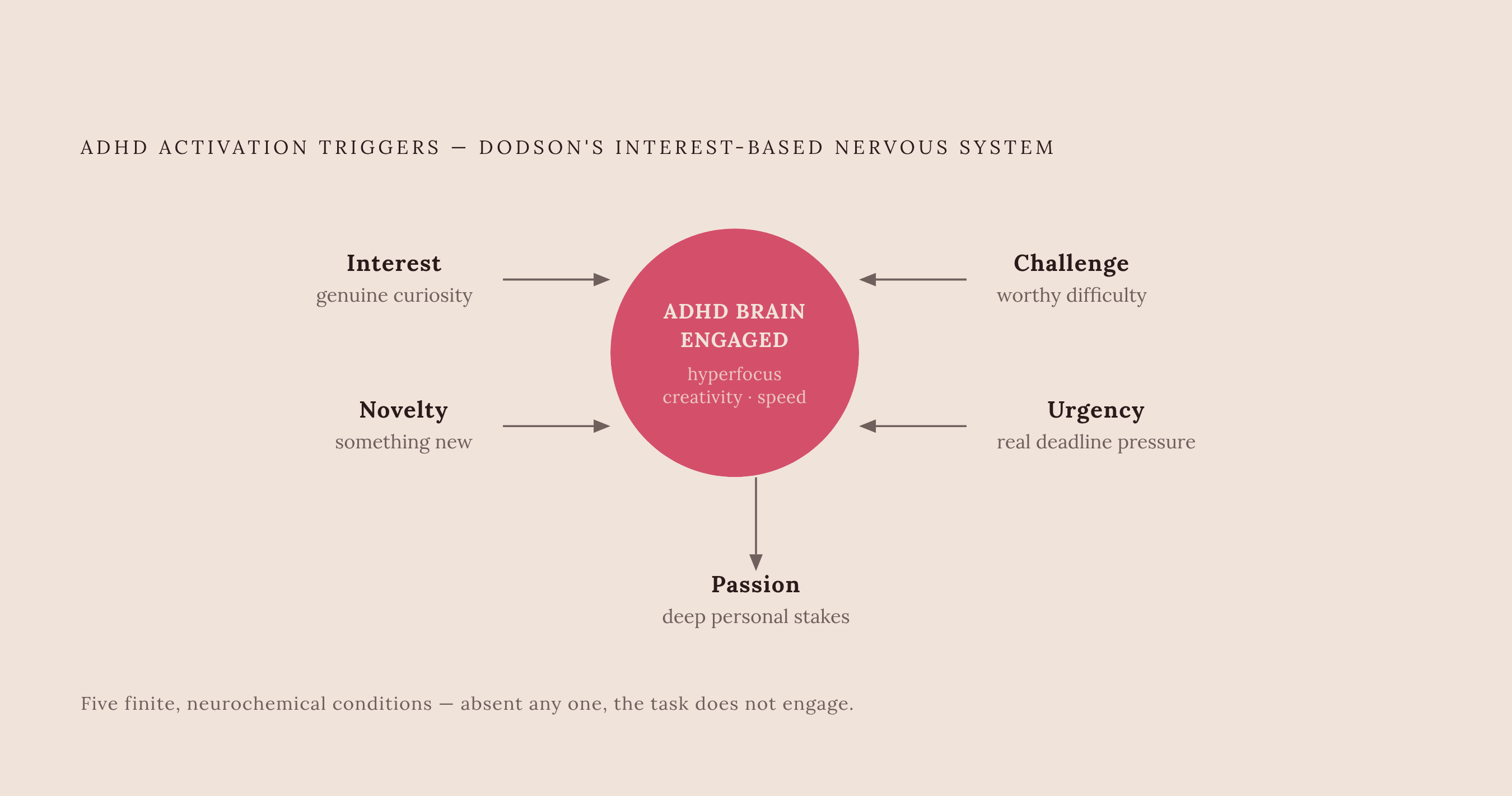
Dr. William Dodson's interest-based nervous system framework names the inputs that actually gate ADHD capability: interest, novelty, challenge, urgency, and passion. The brain is not being inconsistent. It is responding predictably to a specific set of neurochemical triggers, and those triggers were present in the first case and absent in the second.
Understanding this mechanism reframes the entire question of ADHD productivity. The problem is not that strengths are unreliable. The problem is that most environments treat them as though they were personality traits available at will, rather than neurological states that require particular conditions to ignite.
What the research actually shows about ADHD strengths
The strengths themselves are no longer a matter of anecdote. Adults with ADHD were significantly more likely to strongly identify with ten specific strengths, including hyperfocus, creativity, humor, spontaneity, and intuitiveness. Lead researcher Luca Hargitai noted that these findings give an indication of which positive qualities may be tied to ADHD.
The same study found something with deeper practical implications. Across both groups, greater awareness of personal strengths and more frequent use of them correlated with higher well-being, better quality of life, and fewer symptoms of anxiety, depression, and stress. It is not a productivity tactic. It is a mental health intervention.
The evidence base extends beyond self-report. A research editorial in Frontiers in Psychiatry by Hoogman, Zhang, and Greven noted that divergent thinking is positively correlated with ADHD symptoms, and that creative achievements in the domain of expression, including humor, are associated with ADHD. The Attention Deficit Disorder Association adds a critical clarification: these strengths are not symptoms reframed as positives, nor are they coping mechanisms developed to mask difficulties. They are natural traits that can be put to use across different circumstances and environments.
There is a methodological caution worth carrying forward. Radboud's Martine Hoogman emphasized that research on ADHD strengths remains in early stages, and that most prior studies asked only people with ADHD. The direction of the evidence is clear, but the field is still establishing the precise contours of what these strengths are and how they operate. That makes the next section's focus on mechanism all the more essential.
How hyperfocus works as a condition-dependent neurological state
Hyperfocus is the most discussed and most misunderstood ADHD strength. Hyperfocus is not a choice, a mood, or a product of effort. It is a neurological lock-on state that the brain enters involuntarily when its salience and reward systems detect the right inputs.
As Ashinoff and Abu-Akel describe it, hyperfocus involves intense task absorption with reduced awareness of the environment and significant difficulty shifting attention away. The person does not decide to enter hyperfocus. The brain enters it in response to conditions.
Those conditions cluster around identifiable triggers. Interest connects to genuine curiosity or passion. When it does not, no amount of staring at the screen will conjure it.
But hyperfocus is not a reliable ally simply because it has appeared. The same 2025 study by Oroian et al. found productivity gains from hyperfocus at work, particularly in flexible and creative roles, but it also implies a directionality problem. The question is not only whether hyperfocus activates, but whether it lands on the task that actually matters.
The scientific community now treats hyperfocus as a measurable phenomenon rather than a clinical footnote. It does not appear in the DSM-5 diagnostic criteria, yet Hupfeld and colleagues validated a 12-item Dispositional Adult Hyperfocus Questionnaire in 2024. And the practical implication follows directly: if a high-priority task does not naturally carry the triggers, they must be injected artificially through environmental design, entry rituals, or manufactured urgency cues.
What happens when the right conditions never arrive
When those conditions are absent, the same brain does not simply underperform. It reverts to task freeze, routine collapse, and diminished functioning. The failure is structural, not moral.
The underlying mechanism is neurochemical. Baseline dopamine signal in the ADHD reward system runs lower, so generating motivation for tasks that pay off only in the future is disproportionately difficult. The result is a persistent mismatch between the demands of a standard work environment and the operating requirements of the ADHD nervous system.
That mismatch compounds over time. A 2026 scoping review published in Behavioural Sciences found that individuals with ADHD experience difficulties across four main routine domains: sleep hygiene, feeding, physical activity, and sedentary behaviors, with sleep hygiene the most frequently addressed. Degraded sleep and physical health then further suppress the dopamine-activating conditions that ADHD strengths depend on. It is a self-reinforcing cycle.
The person inside that cycle rarely has evidence-based guidance to break it. The same scoping review found no validated assessment tool specifically designed to measure routines or habits in people with ADHD, and existing research remains concentrated primarily in pediatric populations. Adults are navigating a well-documented spiral with tools built for children and assumptions built for neurotypical brains.
The psychological cost is the least visible and most damaging element. A 2025 study by Wurth and colleagues found that adults with ADHD on average agreed they felt the need to mask their personality at school, work, and at home, though masking behavior varied by context. The system failed to account for the brain.
Engineering the conditions that bring ADHD strengths online
Once the mechanism is understood, the path forward becomes concrete. ADHD strengths are gated by specific neurological inputs: interest, novelty, urgency, meaning, and immediate reward. Those inputs can be constructed deliberately. The interest-based nervous system framework provides the design logic at its simplest: if the task does not naturally carry the triggers, inject them artificially.
One structure for doing this is pairing a high-priority but low-interest task with a challenge element, a time constraint, or a competitive angle. A proposal draft becomes a puzzle about structuring the argument elegantly. The content of the task remains the same, but the surrounding conditions now include novelty and urgency, and the brain responds differently to the same work.
Connecting a task to personal values or identity operates through a different channel. The distinction is subtle but consequential: importance is external, while meaning is internal. Dodson's framework separates them for a reason.
Specific techniques operationalize these principles. And body doubling, working in the presence of another person physically or virtually, provides the ambient social stimulation and accountability that activates engagement for tasks that feel too formless or aversive to start alone. The technique is supported by both CHADD and the Cleveland Clinic, and has been operationalized digitally through platforms such as Focusmate.
Exercise deserves particular attention as a routine condition-setter, not an occasional intervention. The ADDA summarizes the broader point: using ADHD strengths intentionally helps build routines and environments that work with the brain. Environmental design is not a workaround. It is a strength-amplification strategy.
How gamification deliberately recreates the dopamine conditions ADHD strengths need
Gamification is often dismissed as a superficial layer of points and badges. In the context of ADHD, that dismissal misses the mechanism entirely. Gamification is the deliberate engineering of immediate, concrete evidence of progress, which is precisely the dopamine-activating input this brain is structurally short on and which environmental design alone often cannot sustain across a long task.
The reason this works traces back to the nature of task freeze. Quest-style framing transforms "write the report" into "complete Level 1: gather research materials," which reduces activation energy and provides the novelty and challenge triggers the brain responds to. XP and reward systems then supply immediate feedback at each step, so dopamine signal is sustained across the task rather than arriving only at completion, when it is too late to matter.
The evidence supports this mechanism. Non-gamified digital training produced substantially weaker results, and most gains were maintained at an 8-week follow-up. For adult professionals, researchers at the 2025 Web for All Conference developed WADAQ, an AI-driven gamification tool designed to enhance cognitive and executive functioning for employees with ADHD in professional settings. The intervention is moving from classroom to workplace.
Why does a conventional productivity tool fail where a gamified one succeeds? But the failure belongs to the tool. It was not designed around how this brain actually generates motivation, and gamification is one of the few approaches that corrects that design error directly.
Reducing task paralysis with low-friction tools that lower the activation threshold
Task paralysis is not resistance to work. The brain requires a certain amount of neurochemical momentum to initiate action, and when a task appears too large, too vague, or too far from any immediate reward, that threshold is not met. Tools that reduce the friction of starting therefore intervene at the precise moment of failure, before the brain must summon engagement from nowhere.
Task size is the primary culprit in freeze. Breaking an overwhelming goal into granular, sequenced milestones removes that ambiguity. The first step is the most neurologically expensive moment in any ADHD workflow, and a tool that constructs that first step has already done the hardest work.
Goblin Tools' Magic ToDo operationalizes this directly. It takes a task that feels too large and breaks it into steps, with a "spiciness" dial that controls how granular those steps become. The attack is precise: rather than asking the user to plan, which itself requires executive function, the tool externalizes the decomposition and attacks the task-initiation freeze at its source.
Voice input represents a different kind of friction reduction. Todoist's Ramble feature lets users speak a messy, unpunctuated thought and converts it into properly structured tasks with projects, due dates, and priorities attached. The tool does that work after the fact.
Working memory support follows the same principle. By capturing everything and delivering a summary and action items, it removes the requirement that working memory hold the content of a call while simultaneously trying to listen to it. These tools do not make anyone smarter or more disciplined. They lower the threshold at which the brain can engage, and once engagement begins, the strengths that were always present have room to operate.
Building habits that preserve the conditions strengths depend on
Engineering conditions once is insufficient. The neurological environment that makes ADHD strengths available must be maintained across days and weeks, and that maintenance cannot depend on fresh effort every morning. Habits and routines are the infrastructure that carries the conditions forward without requiring repeated acts of will.
Structured environments significantly improve attention regulation and reduce anxiety in ADHD. Routines also combat decision fatigue by eliminating the need to decide what to do first, reducing the activation cost of the day's opening moves. A morning that begins with a predetermined sequence does not spend executive function on the first three decisions, and those savings compound across hours.
The primary obstacle is not motivation but a cognitive pattern. Research on family systems and ADHD suggests that consistency, not perfection, is the operative variable for routine formation. A minimal viable routine, even a two- or three-step sequence done reliably, creates more stable conditions for ADHD strengths than an elaborate ideal executed rarely.
Exercise remains among the most evidence-supported elements of such a routine. Physical activity raises dopamine and norepinephrine levels, increases cortical volume, and enhances brain activation and connectivity in cognitive regions, with effects that resemble those of psychostimulants. A daily walk is not a substitute for other interventions, but it is a reliable, low-cost way to maintain the neurochemical baseline that ADHD strengths depend on.
There is an absence in the literature worth acknowledging honestly. The 2026 scoping review in Behavioural Sciences found no validated assessment tool specifically designed to measure routines or habits in individuals with ADHD. The principles are sound even where the measurement lags behind.
What changes when ADHDers stop waiting for their strengths to appear and start designing for them
The most significant shift an ADHDer can make is not behavioral but conceptual. It is the movement from "I hope hyperfocus shows up today" to "I know what conditions my brain needs, and I can build them." The science now supports this shift, and the consequences extend far beyond productivity.
The research from the University of Bath, King's College London, and Radboud University Medical Center found that adults with ADHD who recognize and actively use their strengths report better well-being, higher quality of life, and fewer mental health symptoms. Engineering conditions is not a technique that sits alongside mental health care. It is itself a mental health intervention, because it replaces helpless waiting with a testable model of one's own brain.
Self-stigma works in the opposite direction. Research in Frontiers in Psychology links self-stigma in ADHD to lower self-esteem and poorer mental health outcomes. A person who is constantly performing normality cannot simultaneously create the conditions for genuine absorption in work.
The ADDA frames the shift without sugarcoating the challenge. It is not a denial of challenges. It is a foundation for a system that works with the brain instead of against it.
Generic productivity advice fails ADHDers not because ADHDers are incapable of productivity, but because that advice was designed for a different brain, one motivated by importance and future reward rather than by interest, novelty, urgency, and immediate feedback. The failures were never a verdict on capability. They were a mismatch between operating system and environment.
ADHD strengths are not unreliable windfalls. That is not a guarantee of perfect reliability. It is something better: a framework that makes the appearance of strengths something a person can influence rather than something they must wait for.