ADHD and Divergent Thinking in Creative Fields
Research reveals how ADHD's loose attention filters boost divergent thinking in creative work.
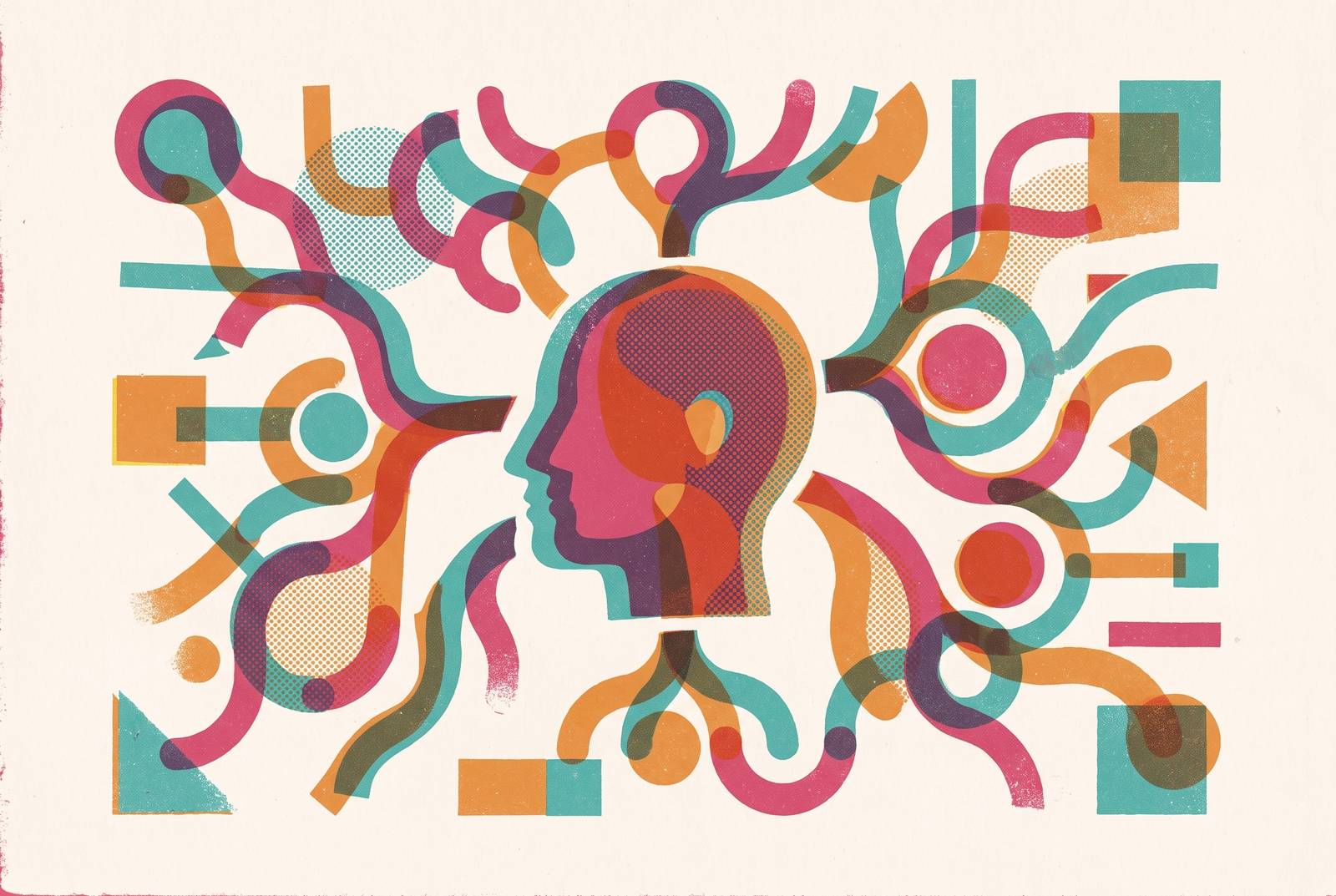
The answer arrives in the shower, mid-conversation, on a walk that had nothing to do with the problem, and it arrives whole, in a way that no amount of sitting at the desk trying harder produced. People with ADHD describe this same pattern when asked how their best ideas actually appear, without ever quite being able to explain the mechanism behind it. The public story about ADHD does not leave much room for that experience; it is built almost entirely out of subtraction: the missed deadline, the lost keys, the unfinished draft, the hours spent unable to start a task everyone agrees matters. None of that is false. But it is a partial account, one that tracks performance failures without asking what the underlying cognitive machinery is actually doing while those failures happen. The same loose filtering and freely moving attention that produce a missed deadline also produce the sideways solution in the shower, and the research into that second half has been building for years.
Divergent thinking and the brain mechanism behind ADHD's effect on it
Divergent thinking is the capacity to generate many different, original solutions to a single problem, and researchers typically score it across three dimensions: fluency, or how many ideas a person produces; flexibility, or how many distinct categories those ideas span; and originality, or how unexpected the connections are. It sits opposite convergent thinking, which does the narrowing work, pulling a wide set of possibilities down to one workable answer, a process that leans hard on sustained evaluative control. ADHD touches both sides of that pair, just in opposite directions. Impulsive thought, the kind that jumps rather than waits, tends to support the open, associative work of divergent ideation. Impaired inhibitory control and a working memory that doesn't hold steady under pressure tend to undercut the evaluative, narrowing work convergent thinking requires.
What connects the two is less about imagination and more about filtering. Most brains run a kind of automatic screen that sorts what comes in into relevant and irrelevant before it ever reaches conscious attention, so the irrelevant material gets discarded before anyone notices it existed. When that screen runs looser, as it appears to in ADHD, more of that discarded material gets through, and some of it turns out to be the unexpected connection that a tighter filter would have thrown away. Emerging neuroimaging work backs this up at the level of brain networks: attention and creativity draw on overlapping circuitry, not separate systems that happen to interact. Defocused attention is cognition, and it runs through the same wiring that handles focus, just engaged differently.
Direct research on ADHD and creativity
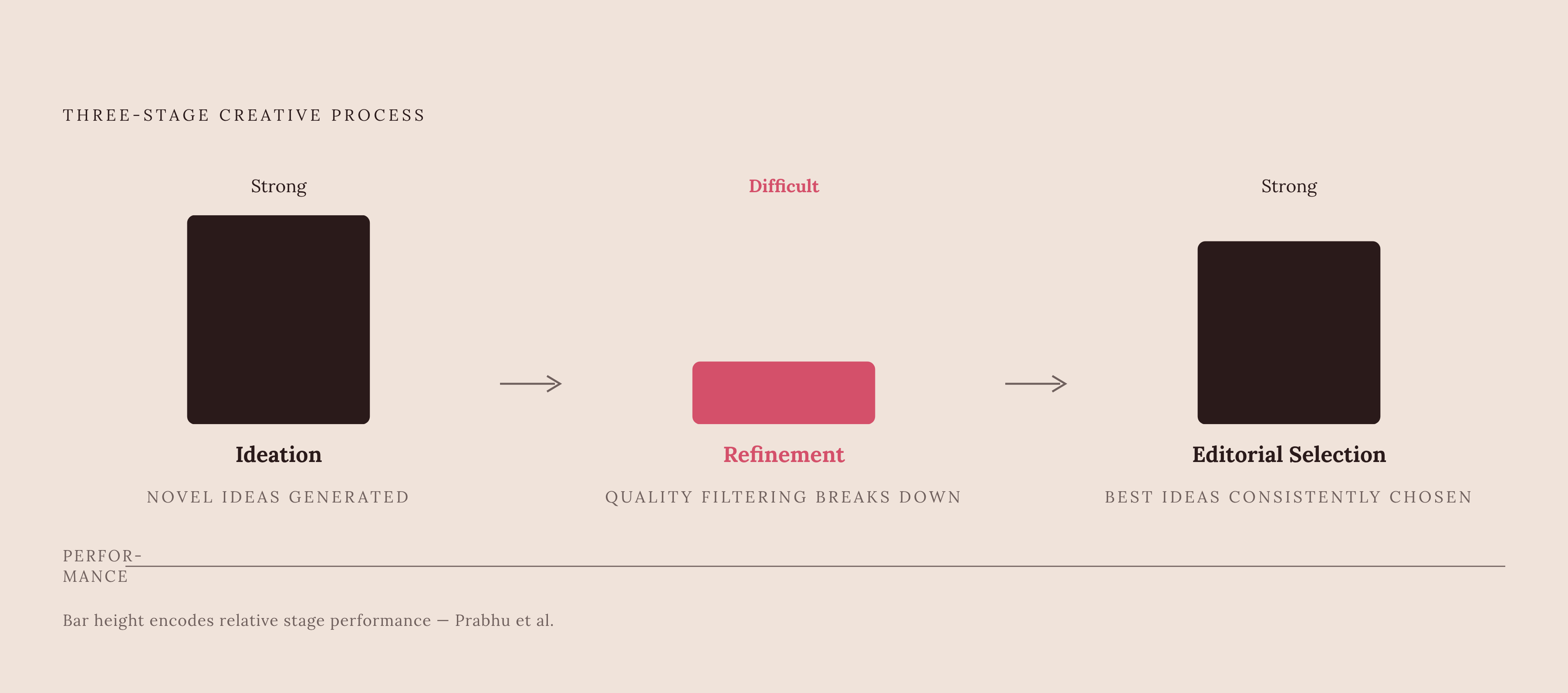
That mechanism has moved from theory into direct experiment, and the results are more specific than the "ADHD makes you creative" headline would suggest. A study by Rohan Prabhu and colleagues at Lafayette College, published in the International Journal of Design Creativity and Innovation, put participants with and without ADHD through both convergent and divergent thinking tasks. Participants with ADHD generated more novel ideas but fewer high-quality ideas overall. At the selection stage, when those same participants chose among their own ideas, they consistently picked the ones that scored high on both novelty and quality. The study's authors also flagged a methodological caution: non-design creativity tasks may not fully represent actual design performance, a reminder that lab measures of creativity and real creative output are not always the same thing.
Put together, you get a three-stage picture of how ADHD shapes the creative process. Ideation volume looks strong. Editorial judgment, the ability to pick the good idea out of a pile once it exists, also looks strong. The difficulty concentrates in the middle: refinement, elaboration, the quality filtering that normally happens during generation.
A separate line of research looks at how ADHD brains actually solve problems, from a different angle. A study led by Hannah Maisano at Drexel University, published in Personality and Individual Differences, tested 299 undergraduate students on Compound Remote Associates puzzles, the kind where three unrelated words share one hidden connecting word. Participants said whether each answer came through step-by-step analysis or sudden insight. Higher ADHD symptom levels predicted a stronger reliance on insight over analysis, and performance followed a U-shaped curve: the highest-symptom and lowest-symptom groups both outperformed the people in the middle.
Timing and motivation complicate the picture further. Research presented at the 2025 ECNP Congress in Amsterdam found that deliberate mind wandering, the kind a person chooses to enter, correlated with greater creativity, while spontaneous mind wandering, the kind that happens without intent, correlated with functional impairment instead. The ADHD trait of mind wandering is not one thing with one effect. Whether it helps or hurts seems to depend on whether the person steered into it. A separate study found that adults with ADHD produced more original ideas specifically when competing for a bonus, which raises a real possibility: goal-directed motivation, not the ADHD trait sitting alone, may be doing some of the work in these findings.
None of this adds up to a settled consensus, and the literature should be read that way. Some studies find enhanced divergent thinking in ADHD. Others find no meaningful difference. A 2025 study by Olga Kuzmina and Margarida Romero at Université Côte d'Azur, published in the Australian Journal of Learning Difficulties, used a modular robotics task with children between 9 and 14 and found no statistically significant difference in divergent thinking components between the ADHD group and neurotypical peers, even though behavioral observation turned up distinct exploratory patterns in how the ADHD children approached the task. What exactly does a null result like that mean for the larger claim? It suggests the advantage, where it occurs, is not uniform across tasks, ages, or methods, and anyone citing this research honestly has to hold that uncertainty alongside the more striking findings.
Where executive dysfunction interferes
The same loosened filter and weaker inhibitory control that widen associative reach also strain working memory, distort time perception, delay task initiation, and make sustained execution harder to hold onto. Russell Barkley's concept of "time blindness," the difficulty perceiving time passing and estimating how long a task will actually take, follows directly from impaired executive function. It is not a personality quirk and not a failure of effort, whatever it might look like from outside.
Task paralysis is where this becomes most visible and most frustrating. The intention to begin is present. What's missing is the activation signal that would turn intention into motion, and that gap traces back to differences in dopamine regulation. A lower dopamine baseline means rewards that sit far off in time barely register as motivators. Knowing a task matters and feeling pulled to start it are two different things, and for an ADHD brain the distance between them runs structurally wider than it does for a neurotypical one.
For anyone working in a creative field, this produces a recognizable and specific pattern. The ideation stage, wide open and generative by nature, tends to flow without much resistance. Then drafting, refining, and finishing arrive, each one demanding sustained convergent effort, and each one runs straight into the wall that executive dysfunction puts up. This is where the "ADHD is a superpower" framing breaks down. The same person capable of generating a dozen original ideas in a single sitting may not be able to carry a single one of them to completion without real structural support built around the work. Creativity and the cost sit on the same circuit. One does not cancel the other out, and treating them as opposites misses what's actually happening inside the brain producing both.
How shame accumulates when the structural problem is misread as a character problem
When one cognitive architecture produces both the creative breakthrough and the repeated failure to finish, and the feedback a person receives only ever addresses the failure, the result over time is shame that settles in and stays. Most mainstream productivity systems assume that writing a commitment down and attaching a deadline supplies enough motivational pull to get the task done. When that assumption fails against an ADHD brain, the system rarely takes the blame. The person does.
A Psychological Medicine study compared adults with ADHD to adults without and found that the ADHD group identified strongly with creativity, humor, spontaneity, and hyperfocus as genuine personal strengths. That self-recognition coexists, often in the same person, with a running undercurrent of self-blame for the structural difficulties the same traits produce. Shame here is not some side effect trailing behind ADHD. It builds up as the residue of years spent measured against standards built for a different cognitive architecture, and it does real damage: it inhibits exactly the risk-taking that creative work depends on. Understanding that the ideation advantage and the execution difficulty trace back to the same source reframes both at once. Neither is a character trait, and neither responds to simply trying harder.
Working with defocused attention deliberately rather than fighting it
The Drexel insight-solving research carries a direct practical implication. If insight-based solving is the dominant mode for brains with higher ADHD symptom levels, forcing a strictly analytic, step-by-step approach to ideation works against the grain of how the brain is already built to solve problems. The better approach creates the conditions where insight has room to arrive on its own terms.
Deliberate mind wandering offers a structured way to do exactly that without losing the whole afternoon to it. Write the problem down in one concrete sentence. Set a short time boundary around the exercise. Release attention inside that boundary. Capture whatever surfaces once the time is up. The 2025 ECNP research draws a clear line between this chosen drift and the spontaneous, uncontrolled kind: the chosen version tied to creativity, while the spontaneous version impaired function instead.
Energy mapping does more for creative output than clock-based scheduling does. ADHD brains do not produce uniform output hour to hour across a day. Some stretches run loose and generative, others don't, and noticing which hours tend toward the former, then protecting them for ideation rather than filling them with email or paperwork, works with the architecture.
Externalizing ideas the moment they appear directly counters the "out of sight, out of mind" quality of ADHD working memory. A voice memo, a whiteboard, a sketchbook, any fast-capture method will do, because an idea that appears during a defocused stretch rarely survives being held only in the head through the next distraction. Speed matters more than the specific tool. Ideas tend to arrive faster than typing can keep up with, and typing itself carries real cognitive overhead when the executive function system running it is already depleted. Capture methods that take only a few seconds per entry keep that ideation channel open instead of letting good material disappear before it reaches the page.
Bridging from ideation to execution, and the structural support the creative phase cannot skip
The core problem on the execution side is a deficit in the initiation signal and in sustained activation, and that distinction matters because it points toward what actually helps: lowering the barrier to starting and supplying feedback the moment it's earned.
Task chunking addresses the difficulty of starting a task directly. An overwhelming creative project often doesn't get started simply because the ADHD brain registers it as one enormous, undifferentiated object with no visible edge to grab. Breaking it into three to five concrete micro-steps turns that mass into a sequence of specific, manageable entries. The bottleneck was never about doing the work once it started. It was about knowing where to start.
The Two-Minute Launch Rule works on the same principle from a different angle: commit to only two minutes of a task, nothing more, and the pressure to complete it disappears along with the resistance to beginning it. Once the activation threshold drops that low, you can start, and continuation tends to follow on its own once momentum exists.
Body doubling supplies a different kind of support, external structure borrowed from another person's presence, physical or virtual, who doesn't need to help with the task or even engage with it directly. The ADHD brain's internal regulation system doesn't reliably generate that kind of grounding on its own, and virtual platforms have turned this once-informal habit into something people can build into a daily practice.
Habit stacking attaches a new creative practice to an anchor that already runs reliably, opening a project file right after making morning coffee, for instance, so that the new habit borrows activation energy from a routine that doesn't require any fresh willpower to execute.
Gamification belongs in this list as something more than a nice extra. For a brain running on a lower dopamine baseline, immediate and visible evidence of progress, whether that's XP, a streak, or a simple completion signal, supplies a reward that an abstract future payoff cannot match. That's a direct neurochemical intervention on the motivation gap itself, not a cosmetic trick, and randomized controlled trials back the research behind it.
What ADHDers in creative fields can do with this picture
None of this research claims ADHD is secretly an advantage in disguise. What it shows is a trait profile that carries real, measurable costs alongside real, measurable assets, and both trace back to the same cognitive architecture, not to anyone's character. For someone working in a creative field, the three-stage model, strong ideation, difficult refinement, strong editorial selection once ideas already exist, suggests that the most productive workflow might look nothing like the one conventional education or a typical workplace rewards. Generating widely, capturing everything without judging it in the moment, stepping back, and evaluating only afterward is a legitimate, evidence-supported way to work. It is not evidence of disorganization.
Recognizing which part of the creative process runs naturally strong, and which part needs scaffolding built around it on purpose, opens the door to designing a work environment around that shape rather than against it: protect the generative hours, build initiation support directly into the execution phase, and choose tools that give immediate feedback and capture ideas with almost no friction.
What changes most, maybe, is how past struggle reads in hindsight. Years spent in environments demanding steady, linear output, environments that penalized the wandering, leaping, burst-and-pause rhythm of ADHD thinking, were never proof of some creative shortfall. They were evidence of a mismatch, a particular cognitive architecture asked to run inside systems that were never built to hold it.
Sources
- Thinking (neuro)divergently! Exploring the effects of ADHD on designers’ performance in convergent and divergent thinking tasks: International Journal of Design Creativity and Innovation: Vol 14, No 2
- Full article: Study of divergent thinking and task performance in children with ADHD through a modular robotic task