Task Initiation Strategies That Match How ADHD Motivation Actually Works
Matching task setup to how ADHD dopamine and activation actually work beats willpower-based advice.
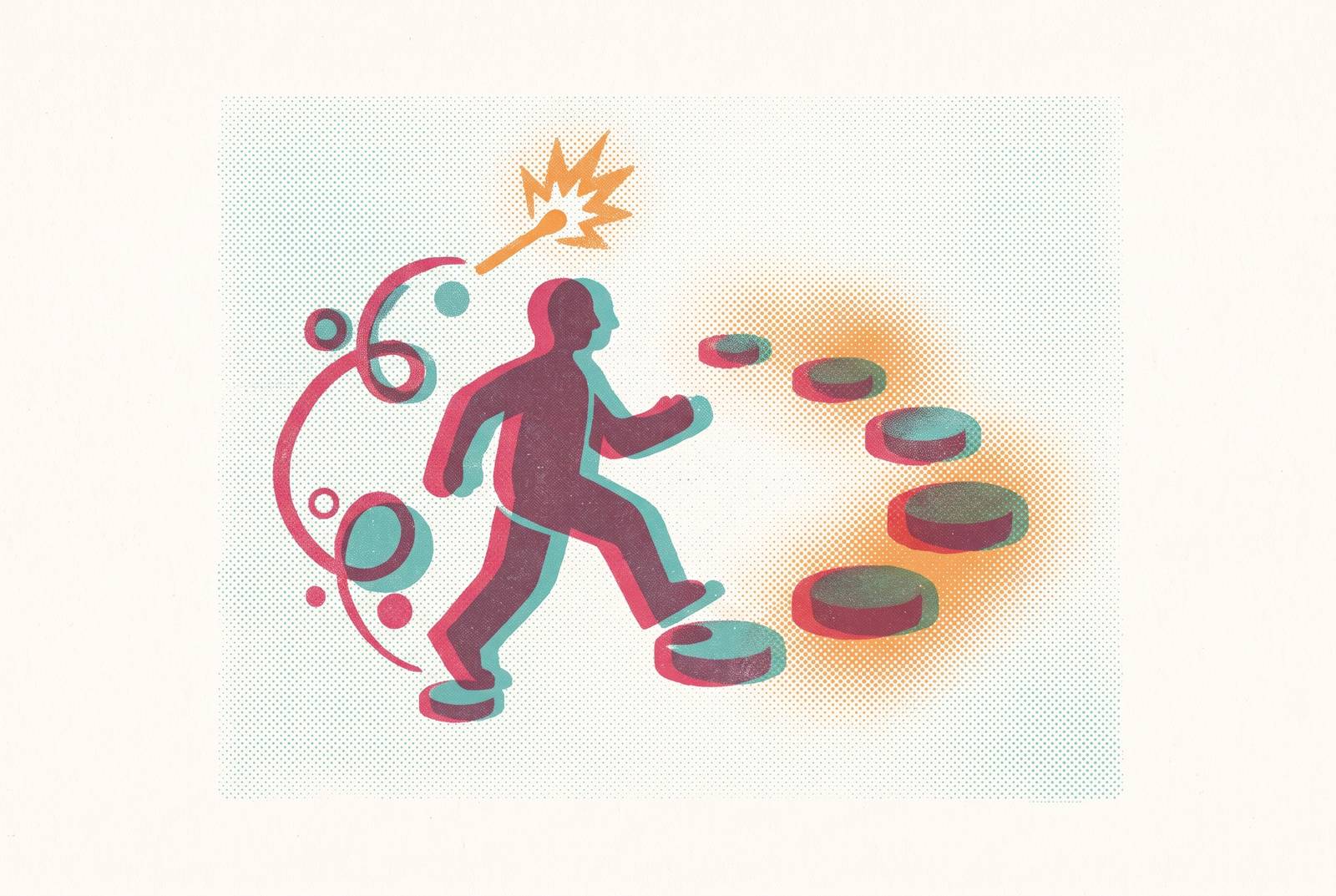
Gamified goal tracking for adults with ADHD is most useful when immediate, visible rewards support a small, clearly defined action. Forest’s growth model and Todoist’s Karma points illustrate different ways to make progress tangible. But task initiation strategies must address more than rewards, because starting depends on the fit between a task’s demands and the brain’s available activation.
Why task initiation is a neurobiological problem, not a willpower problem
The cursor waits, and your hands stay still. You know what the email needs to say, understand why it is important, and want it sent. Yet intention does not become movement. Task initiation is the executive function that makes that conversion, and ADHD can impair it even when the goal is clear. Advice to “just start” assumes the very capacity that is failing.
Volkow et al.’s 2009 study in JAMA found lower dopamine activity in adults with ADHD in the nucleus accumbens, midbrain, and caudate, regions involved in reward and starting behavior. Dopamine helps tell the brain that an action is worth starting. Prefrontal cortical networks, particularly the dlPFC and ACC, support working memory, inhibitory control, and cognitive flexibility. Reduced prefrontal regulation of the amygdala, involved in emotional reactivity, adds another burden under cognitive or emotional strain.
This distinction changes how delay should be interpreted. Intentional postponement and task paralysis can look identical from outside, but paralysis describes wanting to act while feeling unable to initiate. Not every delayed task has the same explanation. When executive dysfunction makes it hard to start, advice to be more committed misses the difficulty and can add emotional pressure.
How the interest-based nervous system shapes which tasks the ADHD brain will actually start
Why can a two-line email remain untouched while an absorbing topic holds attention for hours? The contrast can reveal which task qualities support activation. Interest, novelty, challenge, urgency, and social connection may engage an ADHD brain more readily than importance or distant benefit. The goal can be deeply valued without feeling actionable. Hyperfocus and initiation failure are therefore not necessarily contradictory.
Clinician William Dodson’s “interest-based nervous system” offers a useful vocabulary for this pattern, though it is not a settled scientific explanation. The INCUP framework names tasks that are Interesting, Novel, Challenging, Urgent, or People-Oriented. As a practical lens, it invites a more precise question than whether motivation is present. Was the task that started easily novel, socially engaging, or close to a deadline? What was missing from the task that stayed stuck?
The framework is not a DSM diagnostic category or a formally tested predictive model, and ADHD presentations differ in their executive function profiles. Some difficulties center on initiation, others on working memory or emotional regulation. Treating ADHD as merely an interest problem risks turning a neurological condition into a preference problem. INCUP can help show what makes starting easier without suggesting that making every task fun will fix the impairment.
How shame compounds initiation failure and why addressing it is part of the strategy
A task remains undone, self-criticism follows, and the next attempt begins with the weight of the previous failure. The task now feels harder to approach. Shame feeds the avoidance cycle rather than simply appearing after it, particularly when difficulty starting becomes evidence of a supposedly defective character. With emotional regulation already strained, that added burden can deepen the freeze.
A 2025 study in PLOS ONE examined validation-seeking and self-image in self-diagnosed and clinically diagnosed individuals. Participants described ADHD-related inaction as damaging adolescence and becoming a source of self-contempt. A separate 2025 study of adolescents found associations between ADHD diagnosis identity and self-management, distinguishing rejection or engulfment from acceptance or enrichment. Those findings support treating identity as functionally relevant, while acceptance alone remains unproven as a resolution for adult initiation failure.
Approaching a strategy as an accommodation for an executive difficulty leaves room to try it without making every outcome a verdict on personal worth. That psychological room makes the following tools more accessible.
If-then planning: how a pre-made decision bypasses the moment of initiation failure
An if-then plan moves a decision away from the moment when making it is hardest. Instead of holding a broad intention to work on a document, you connect an observable cue to one defined response. For example, when you sit down after lunch, the next action is to open the document and type one sentence. The cue tells you when to start, so you can skip deciding again about timing, what comes first, and how much effort to put in.
Gawrilow and Gollwitzer found that children with ADHD given if-then plans on a go/no-go task reached the response-inhibition level of children without ADHD. This is a useful but bounded finding. Response inhibition in a structured task is not the same as adult task initiation in daily life. The result nevertheless suggests that preselected cues and responses can support executive performance that is weaker under unplanned conditions.
The plan should name a situation. “When you sit down after lunch” identifies something observable, while waiting to feel ready leaves activation unresolved. Planning itself also requires executive function, so the useful time to build the plan is a low-demand moment, using a simple template. Even with a clear cue, the “then” needs to be small enough to begin.
Task decomposition: shrinking the first step until starting costs less than avoiding
The desk gets reorganized, the research loop continues, or the whole task plays out repeatedly in your head. Preparation consumes energy without producing the first movement. These activities can feel close to starting because they concern the task, yet mental rehearsal may exhaust resources before action begins. The first step often represents a commitment large enough to impede starting.
Decomposition reduces that commitment. “Clean the kitchen” asks the brain to represent a whole sequence, including decisions not yet made. “Move the three cups from the counter to the sink” names a physical action with a clear boundary. There is less to hold in mind. The aim is to lower activation cost until starting feels easier than continuing to avoid the task.
A two-minute timer sets another limit on how much work to take on. Permission to stop when it rings remains part of the method once work begins. The task becomes a brief attempt rather than an implied obligation to finish everything. This targets the demand at the entry point, though some blocked tasks may remain unmanageable.
A morning can be decomposed not only into actions, but into choices that no longer need to be made while it unfolds.
Morning architecture: building a sequence the ADHD brain can run without deciding
Clothing is already decided, breakfast is already chosen, and keys, bag, and medication have fixed places. The morning begins with actions rather than a search for options. This is environmental scaffolding. Each choice made beforehand preserves executive resources for the sequence itself and, eventually, the first work task.
Consistency is more useful here than an elaborate timetable. A fixed order can become familiar enough to require less active decision-making, whereas redesigning the morning creates another planning task. If planning remains part of the morning, the approach is to keep it short and template-driven. The routine can be assessed by how much thought it demands before anything gets done.
This distinction also gives the sequence a practical test. Does it call for remembering where things were left, choosing from several breakfasts, and deciding what comes next? Those are demands that physical placement and prior decisions can remove. A system that requires substantial executive effort to operate reproduces the difficulty it is meant to relieve.
Different ADHD presentations will need different sequences. The common principle is to externalize decisions where possible, rather than assume that a particular order or schedule will suit everyone. Once those decisions are out of the way, doing the tasks may still bring too little reward right away.
How can XP and rewards help adults with ADHD when regular to-do lists stop working?
A to-do list records obligations, but recording an obligation does not necessarily make its future benefit motivating. Gamification changes the timing of feedback. An XP gain, a streak, or a visual completion marker makes progress available before a distant goal is achieved. The neurological rationale concerns reward processing, including reduced ventral striatal activation in ADHD. It is not simply that a more colorful list is more enjoyable.
Forest uses a growth model for gamified focus, so growth shows the time spent engaged. Todoist’s Karma system uses points and streak bonuses to show progress as a score. Neither example establishes that one app treats ADHD or works best for every adult.
For ADHD-specific setup, the principles already established still apply. A reward attached to “clean the kitchen” leaves the difficult entry point intact, while feedback connected to a concrete, decomposed action brings progress within reach. The relevant criteria are immediate feedback, visible progress, and low operating effort. A reward system that requires extensive upkeep can become another executive demand.
What happens when the novelty wears off? Familiar feedback can remain useful because novelty is not the only source of engagement, but that does not guarantee that every game-like system will stay effective. Some people find gamification patronizing, and some designs provide little useful reinforcement. Feedback needs to make it easier to start or keep going, whatever the app looks like.
Body doubling: how the presence of another person or AI agent lowers the cost of starting
Body doubling means working with someone present to provide an external anchor for attention and accountability. The person does not need to perform the task for you. The proposed benefit is borrowed regulation when self-regulation is depleted, extending support beyond what a private plan can supply.
Ara et al.’s 2025 VR study, You Are Not Alone, compared a small group of adults with ADHD working alone, with a human body double, and with an AI body double. Participants finished tasks faster and reported greater accuracy and sustained attention in both body-doubling conditions than when alone. The study found no significant difference between the human and AI conditions. That result is promising, but limited in scope. A small VR study does not show that every AI companion gives the same support in day-to-day work.
That possibility still matters because co-working with a person means finding a time to meet and can bring social pressure. For someone who fears judgment, another person’s presence may increase the load. Virtual or AI-mediated presence may provide accountability while feeling less socially threatening, though people will respond in different ways. Having company can feel supportive or like being watched, so the choice goes beyond working alone or with someone else.
Combining strategies: matching the approach to what is actually blocking initiation right now
Is the opening action undefined, the decision still pending, or the reward too remote? Is isolation allowing attention to drift, or is shame making an ordinary task feel threatening? Those barriers call for different supports. A toolkit becomes useful through matching.
Strategies can also address different parts of the same blockage. An if-then plan can supply the cue while decomposition defines a manageable response, and visible feedback can make that response feel consequential. Adding tools indiscriminately, however, risks creating more decisions and upkeep. The aim is enough support for the active barrier.
Difficulty starting is not evidence of a broken person. ADHD brains need support that fits how activation, reward, and regulation work, without tying a person's worth to how much they get done.