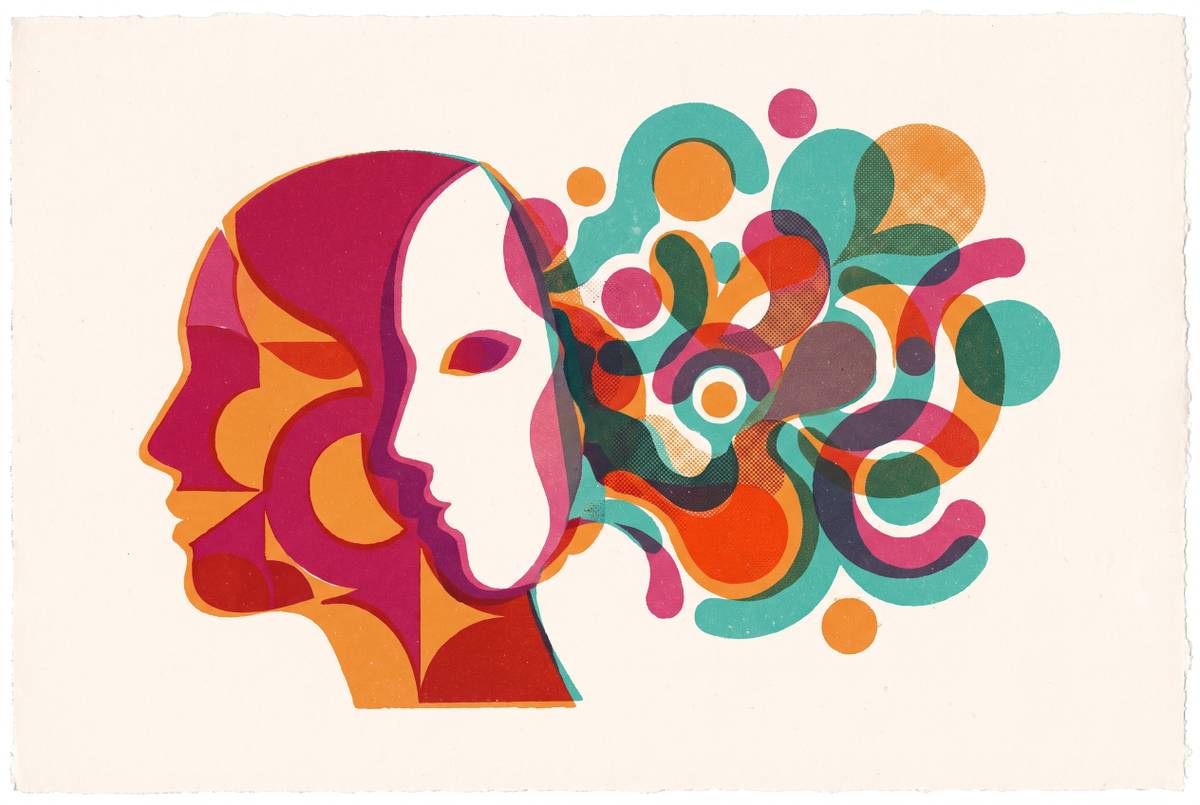
Unmasking ADHD Without Losing Professional Credibility
Exhaustion at work may signal ADHD masking, not laziness or poor motivation.

The exhaustion that comes from years of compensating at work reflects an accumulated cost, not a personal failing. It is the accumulated cost of running a second, invisible job alongside the visible one: tracking what neurotypical colleagues absorb automatically, rehearsing responses before meetings, double-checking whether an email sounds "normal." Masking, in this context, is an adaptation to a workplace that was never built with a particular kind of brain in mind.
The mismatch is structural. Office work runs on constant self-initiation, the expectation that a person will start tasks, sustain them, switch between them, and reprioritize without external prompting, and self-initiation happens to be the executive function that ADHD brains struggle with most. That's the whole problem in miniature: the job asks for something the brain does not reliably generate on its own, so the person substitutes willpower, adrenaline, and constant vigilance instead. Managers rarely see it that way. The gap between what an ADHD professional produces and what the role expects gets read as poor motivation, disorganization, or inconsistent effort, rather than as a cognitive difference that might call for different working conditions.
What's striking is where the mask actually slips. It is not on the big, adrenaline-soaked deadline, where urgency itself supplies the executive function that's otherwise missing. Occupational research on masking breakdown points instead to the quieter terrain: routine administration, multi-stream communication, and the general workload structure that most jobs run on. That is the invisible daily fabric of professional life, the parts nobody praises anyone for handling well, and precisely the parts an ADHD brain finds hardest to sustain without support.
For a while, compensation works. Then it doesn't. A workload increase, a reorganization, a stretch of accumulated stress, and the coping strategies that held for years stop holding, often abruptly and confusingly, for the person and for everyone around them. The consequences are not abstract. A study published in the Journal of Occupational Rehabilitation found that time management problems specifically predicted lower income, more disciplinary action, greater boredom at work, and lower satisfaction with coworkers and supervisors. Those are concrete, cumulative outcomes, not vague impressions of underperformance.
Sustained masking carries a personal cost on top of the occupational one. Sustained masking draws from the same limited pool of executive function that the actual job requires, so the more energy spent appearing composed, the less remains for the work itself. That is the quiet arithmetic of masking: every hour spent managing perception is an hour not spent managing the task.
Disclosure decisions involve several factors, and honesty alone doesn't decide them
Deciding whether to tell anyone at work about an ADHD diagnosis gets framed, often by well-meaning advice, as a question of authenticity: be yourself, or keep hiding. That framing misses what the decision actually involves. Disclosure is a calculated risk assessment across several distinct dimensions, each of which deserves its own separate consideration rather than a single yes-or-no verdict.
Those dimensions do not collapse into one choice. Telling HR for the purpose of a formal accommodation is a legally and structurally different act from telling a direct manager in confidence, and telling a manager is different again from mentioning it in passing to a trusted peer. Each carries its own audience, its own permanence, and its own consequences if the relationship changes. Treating all three as versions of the same disclosure, as though the decision were binary, obscures how much control a person actually has over the shape of what gets shared.
The scale of who's making this decision matters too. Around 15.5 million U.S. The CDC's National Health Statistics Report puts the number at around 15.5 million U.S. adults carrying an ADHD diagnosis, and a large share of them are working through this calculus mid-career, inside an established professional identity, without the luxury of starting fresh somewhere no one has formed an opinion yet. Stigma perception shapes the decision as much as any practical concern: research on emerging adults found that whether someone discloses is closely tied to how they personally relate to their diagnosis and how they read the surrounding stigma around mental health more broadly. That's a useful thing to sit with. Nobody here is choosing between truth and lies. They're reading a room, a manager, an industry, and deciding how much of the picture that room can currently hold.
It's a set of smaller, more answerable ones: to whom, for what purpose, at what level of detail, and at what point in the relationship or the role. Answering those one at a time turns an overwhelming decision into a series of manageable ones, each revisable as circumstances change.
How to read your workplace before deciding how much to reveal
Before any of those smaller questions can be answered honestly, the environment itself needs reading. The specific workplace matters more than any universal principle about openness in a disclosure decision. It's the specific workplace: its industry culture, the disposition of the manager involved, and the organization's track record with accommodation requests generally.
Some signals are easier to read than others. A psychologically safer environment tends to have managers who talk about performance struggles in structural terms rather than character terms, an HR function with demonstrated experience actually handling reasonable adjustments (not just a policy page), and a team where some degree of neurodivergence is already visible and treated as unremarkable. None of these guarantee a good outcome. Their absence is itself useful information worth registering before disclosing anything formal.
It helps to know that formal and informal disclosure are legally separable. Eligibility for a workplace accommodation under the ADA in the US, or under the Equality Act 2010 in the UK, does not require disclosing a diagnosis to an entire team. It requires showing that a condition has a substantial, long-term effect on the ability to carry out normal day-to-day activities, and the rules differ by jurisdiction, so this is a starting point for a conversation with HR or legal counsel rather than a substitute for one. The scope of disclosure, in other words, can stay narrow even when the accommodation itself is real and formally recognized.
One low-stakes way to test the water before committing to anything: watch how an organization responds when a colleague, any colleague, asks for a different working arrangement. Remote days, written briefs instead of verbal instructions, structured check-ins. How that request gets handled, whether it's treated as reasonable or as suspicious, tells a person more about the actual accommodation culture than the employee handbook ever will.
There's a broader shift underway that makes this reading exercise less of a private guessing game than it used to be. Neurodivergent professionals, a group representing an estimated 17 to 20 percent of the population according to a narrative review in Frontiers in Psychology, are increasingly weighing workplace environment as a factor in career decisions from the start, rather than discovering the mismatch after signing on. That changes what's realistic to ask for, and it changes how unusual the asking actually is.
Disclosure with a specific purpose: asking for accommodations without losing authority
Formal accommodation requests carry the highest stakes in this whole calculus, because they're the version of disclosure most likely to become part of the highest-stakes, most acute credibility concern. They're also, done well, the version least likely to damage professional standing, because the framing is within the disclosing person's control.
The shift that matters here is small but consequential: framing the request around what's needed to do the job well, rather than around what's wrong with the person asking. That reframe turns the conversation from a confession into a professional problem-solving discussion, and several accommodations lend themselves naturally to that framing without a diagnosis needing to be named.
A written brief after a verbal meeting is one example. Leaving a meeting unable to reconstruct what was actually agreed to, sometimes called meeting fog, is a recognized ADHD failure mode, but a request for written follow-up solves a visible professional problem regardless of whether ADHD enters the conversation. Regular short check-ins with a manager can be framed as structured accountability rather than oversight. Flexible start times can be framed around when focus and energy actually peak, a claim almost any manager will find reasonable on its face. And reduced exposure to open-plan interruptions, or blocked-off focus time, addresses what occupational research identifies as one of the costliest triggers for executive function breakdown: constant interruption and task-switching.
Timing shapes how these requests land. A track record of consistent delivery before the request makes an accommodation read as professional optimization, the kind of adjustment any high performer might reasonably want, rather than as a plea for leniency. That's an accurate observation about how credibility gets built before it gets spent, not a strategy of deception.
One objection surfaces reliably in this situation: asking for these things might make people wonder why they're needed. In practice, most of these requests describe good working conditions that would benefit almost anyone on a team, regardless of diagnosis, and asking for them without ever invoking a diagnostic label is entirely legitimate. Framed that way, they tend to draw little comment.
Selective disclosure to peers and managers: relationship context and the calculus
Formal accommodation is one register. Telling a manager or a colleague, informally, in confidence, is a different act entirely, and it's probably the one that carries the most emotional weight of anything in this piece.
Informal disclosure can meaningfully reduce the daily friction of masking, the constant low hum of managing appearances, without triggering the visibility or paperwork of a formal process. But it only works if the relationship can actually hold the information. Telling a manager who is warm and sympathetic but has no real influence over working conditions creates intimacy without any practical benefit. The goal is to change the conditions of the work itself, and a disclosure that doesn't do that has cost something for very little in return.
So how does a person judge whether a relationship can hold this? A few signals tend to be reliable: a manager who already adjusts working styles for different people without demanding justification first, one who talks about someone's inconsistencies as a structural issue rather than a character flaw, and one who has already shown discretion with other sensitive information, personal or professional. None of these are guarantees. Their absence is a warning worth taking seriously, and getting this wrong, telling the wrong person at the wrong time, carries a real cost that no amount of careful phrasing fully insures against.
Peer disclosure does something slightly different from manager disclosure. It doesn't change formal working conditions, but it reduces the social performance cost of everyday interactions: explaining why something needs to be in writing, why a meeting detail got missed, why a person went quiet for a stretch mid-project. Research on ADHD professionals notes that many compensate effectively for years before anything visibly breaks. Peers have often already noticed the inconsistencies. They just haven't attributed them to anything. Naming the reason, in the right relationship, can retroactively reframe a pattern that colleagues had quietly filed under unreliable, turning it into something closer to understood.
Building structural scaffolding that reduces how much disclosure is necessary
Reducing how often executive function failures happen can sidestep the need for disclosure, at least for a while. The most durable credibility strategy available to an ADHD professional is lowering the frequency of the executive function breakdowns that create the perception problem to begin with.
External structure does the work that internal initiation and organization don't reliably do on their own. Capturing tasks in writing the moment they occur, before the thought evaporates, converts what NeuroDiversion research frames as email avoidance, unfinished projects, and meeting fog from motivation failures into logistics problems, which are far easier to solve. Setting an artificial deadline with social weight attached, a peer review scheduled for Thursday ahead of a Friday delivery, produces roughly the same neurochemical urgency as the real deadline, without carrying the same stakes if something slips.
Grouping similar tasks into themed blocks of the day cuts down on the switching costs that come from constant context changes, one of the highest-cost failure modes identified in ADHD workplace research. And tools built around low-friction, voice-first capture matter because the underlying design principle across effective ADHD productivity systems is friction minimization: preserving a thought before it disappears, without demanding the same initiation effort that opening an app and typing requires.
Even the physical environment carries some of this weight. Cognitive ergonomics research found that sensory-predictable, structured environments substantially reduce ADHD-related daily stress. The space itself can absorb some of the executive function labor that would otherwise fall entirely on the person working inside it. Tools built around milestone tracking, small reward loops, and guided sequencing for repetitive routines work for the same underlying reason: they externalize initiation instead of demanding more discipline from a system that's already stretched. None of this is about faking neurotypical performance. It's about removing enough of the structural friction that masking stops feeling like the only option available.
Managing the moments when ADHD becomes visible despite the systems
Even solid scaffolding has gaps. A deadline gets missed, a commitment slips, attention wanders visibly in a meeting that mattered. What happens after that moment, more than the moment itself, tends to determine what it costs long-term, and the response to it can be prepared for in advance.
Two failure modes occur in that moment, and both make things worse. Over-explaining raises more questions than it settles, turning a small lapse into a longer conversation nobody asked for. Under-addressing it does the opposite kind of damage: it lets an inaccurate story, laziness, disinterest, carelessness, fill the silence where an explanation should have gone. A prepared response sits between those two extremes. It names the gap concretely, states what changes going forward, and moves on, without apologizing for a trait or promising a kind of consistency that isn't realistic to guarantee.
Where accommodations or working arrangements are already in place, a visible gap becomes easier to explain honestly, in terms of conditions rather than character: a meeting overload that week, a brief that didn't get written down, one too many context switches back to back. That language isn't evasive. Research on occupational outcomes shows that ADHD's effect on job performance runs through specific executive function deficits, chiefly time management and self-organization, rather than through any deficit in general capability. That distinction gives a person precise, non-stigmatizing words for what happened, instead of a vague apology that invites the listener to fill in the blank with something worse.
It's worth being careful not to overcorrect into a different kind of exaggeration here. Hyperfocus and strong pattern recognition can produce genuinely fast or creative work under the right conditions. But they don't cancel out the difficulty, and leaning too hard on the idea of a hidden superpower can feel dismissive to someone standing in the middle of an actual professional setback. The more honest claim is narrower: the same brain that struggles with initiation and follow-through can, under specific conditions, do strong work, and naming both halves accurately is part of credible self-advocacy.
Deciding what level of openness fits the career stage
Nothing about any of this resolves into a single correct answer. The right degree of openness is the one that serves professional goals, protects wellbeing, and matches the actual environment someone is standing in, not some other person's environment or some general rule about honesty at work. And because all three of those things shift over time, the right level of openness now is not necessarily the right level later on.
Career stage changes the math considerably. Earlier in a career, there's less of a track record to lean on, and a disclosure has to work harder to read as self-knowledge rather than as an excuse offered in advance of a problem. Later, with years of demonstrated delivery behind it, the same disclosure carries a different weight. It arrives backed by evidence, not instead of it.
None of the frameworks in this piece, reading the room, requesting accommodations on professional terms, choosing who to trust informally, building scaffolding that lowers the stakes of any of it, are meant to be applied once and left alone. They're meant to be revisited as the job changes, as the manager changes, as the track record lengthens. The exhaustion described at the start of this piece doesn't disappear the moment someone discloses. But the calculus becomes more deliberate, and that alone is worth the effort of working through it.
Sources
- Predicting Occupational Outcomes for Individuals with ADHD: The Role of Hyperactivity/Impulsivity and Executive Functioning - PMC
- 2026 Guide: ADHD-Friendly Home Office Setup & Focus Trends
- Executive Dysfunction at Work: Patterns and Accommodations | NeuroDiversion
- Executive Function Difficulties at Work - Workforce Wellbeing