ADHD Apps and Tools for Task Initiation and Task Freeze
Three tools shrink the effort required to start when ADHD makes beginning feel impossible.
For ADHD task paralysis and executive dysfunction, the most useful app targets the obstacle to starting. Goblin Tools / Magic ToDo breaks vague tasks into concrete steps, Focusmate supplies social presence, and TickTick connects tasks, calendar, and a focus timer. These tools address task freeze as an activation problem by reducing what the brain must do before the first move.
Why task freeze is not a willpower failure
You are sitting in front of a task you care about, know how to do, and genuinely want to begin. Yet nothing happens. The gap between intention and action can look like indifference from outside and feel like a personal failure from within. But task initiation is an executive function, the mechanism that converts an intention into a first movement. Its failure does not require a lack of motivation, ability, or desire.
Volkow et al.’s 2009 JAMA study reported reduced dopamine markers in reward regions of adults with ADHD, associated with symptoms of inattention. A later analysis linked those markers with lower motivation scores. These findings help explain why work may feel harder to start when its payoff comes later. The research supports a biological explanation for why starting is hard, though it does not explain every time every person freezes.
That distinction changes what kind of help makes sense. Choosing to delay a task is different from wanting to begin but being unable to activate, even if both leave the same unfinished work. A task can ask for more executive bandwidth than a person has before any work starts. Initiation failure also differs from time blindness, which concerns sensing time. A tool that makes the passing minutes visible may therefore leave the starting barrier untouched.
What the ADHD brain actually needs to move — the activation-cost model
Activation cost is the effort required before meaningful work can begin, including deciding what to do, locating the first action, and generating enough pull to attempt it. How much must happen before anything happens? A system can reduce that burden without changing the task’s importance or asking the person to care more.
Psychiatrist Dr. William Dodson describes ADHD through the framing of an interest-based nervous system, which tends to respond to interest, novelty, urgency, or challenge. Much common productivity advice assumes that people act once they know what matters most. In ADHD, that connection may be precisely where the difficulty lies. A more complete task list may not help someone make it.
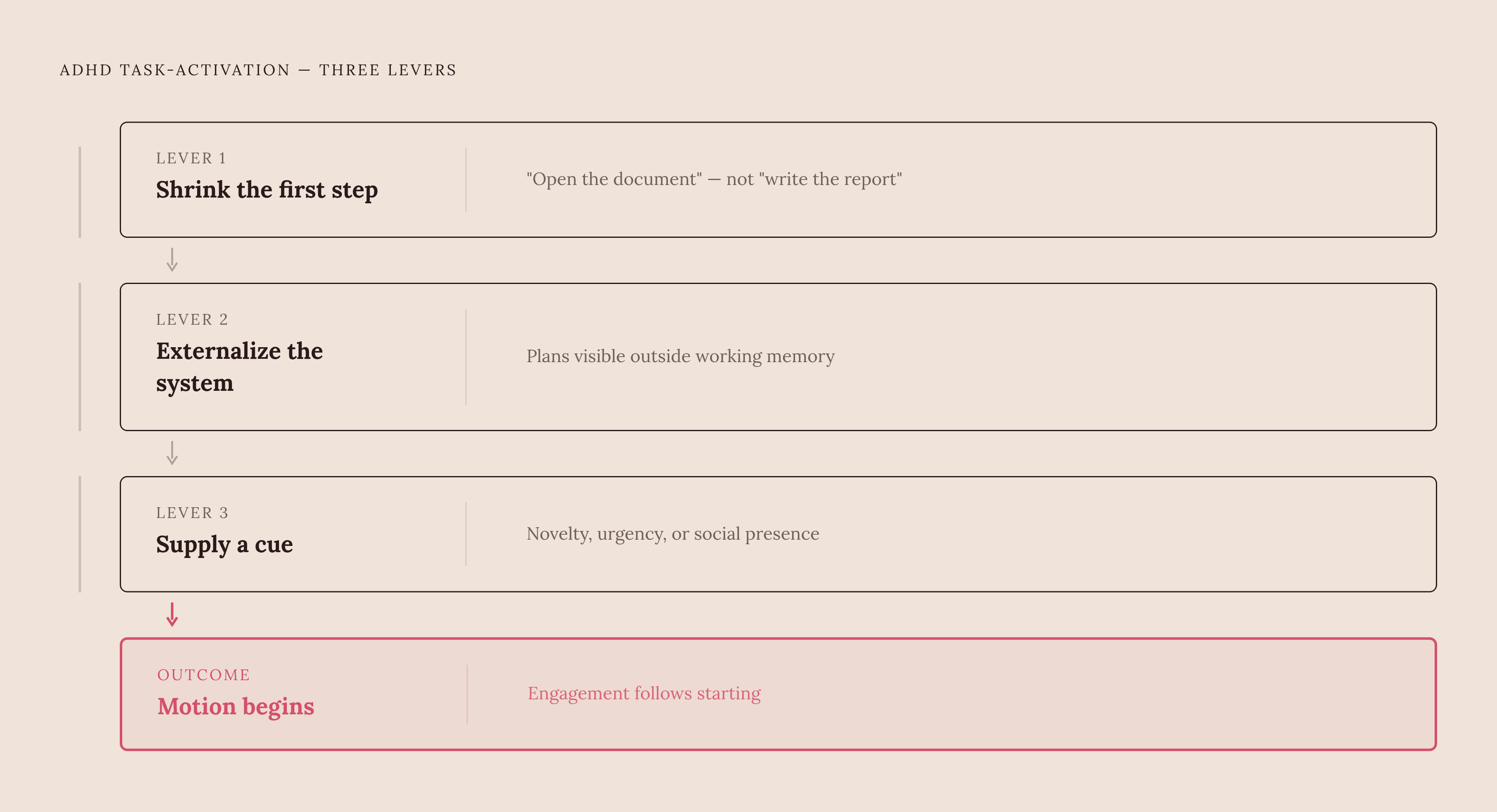
Three levers organize the approaches that follow. Shrinking the first step replaces “write the report” with “open the document,” leaving no decision inside the first move. Externalizing the system moves plans and sequences out of working memory and into a visible structure. Supplying a cue introduces interest, novelty, urgency, or social presence where the task provides little pull of its own. The immediate target is motion, because engagement often follows once starting has occurred.
Technique families with the strongest evidence base
Pre-commitment planning, micro-task decomposition, and borrowed regulation through social presence are the main ways of shaping behavior that initiation tools build on. Their evidence is not equally mature. A controlled task that tests executive function, a coping strategy, and a practice that a community supports each answer different questions. The useful comparison is therefore not simply whether each approach “works,” but which starting burden it removes and how directly the available research addresses that burden.
If-then planning pairs a specific cue with a concrete action before the moment of difficulty. Gawrilow and Gollwitzer found that if-then plans brought children with ADHD’s response inhibition on a go/no-go task up to the level of children without ADHD. That is a promising signal whose relevance to everyday adult task freeze remains unproven. Its relevance is the pre-made decision. A calendar block provides the “when” that a task-list entry leaves open, although the first action still needs to be clear.
Micro-task decomposition addresses that remaining ambiguity by replacing a project with small physical actions. The next action is already written down. If opening the document remains too demanding, the actual entrance may be sitting in the chair or finding the file. The purpose is not elaborate organization, but removing the decision that would otherwise stand at each threshold. This explains why a shorter, more concrete sequence can be more useful than a comprehensive project description.
Body doubling addresses a different gap by placing another person in the working environment, either in the same room or on a video call. Early research on shared presence suggests benefits for task engagement, while the mechanism remains incompletely established. Community support for the practice is strong. Other approaches deliberately introduce an activation trigger, such as a changed location for novelty, a visible timer for urgency, or a measurable challenge.
Why gamification is not a gimmick for ADHD brains
Points, timed challenges, and progress that people can see give them feedback sooner after the action that earns it. That timing is the central rationale for ADHD gamification. When a task’s later payoff does little to draw someone in now, a game element can give them a more concrete reward cue. The feedback’s value depends on whether it helps bridge the gap between wanting an outcome and beginning the work.
EndeavorRx is a documented example of a game built around attention function, with specific sensory stimuli and motor challenges that happen at the same time. Its challenges adjust dynamically to the user’s performance. Building a game for that purpose differs from adding points to an ordinary task manager. It also does not establish that every gamified productivity app treats ADHD or that every reward mechanic improves initiation. The rationale for immediate feedback is stronger than any blanket claim about games.
The strongest objection concerns dependence on external rewards and what happens when those rewards stop. A broken streak can become a verdict. Travel or illness may interrupt progress, and an all-or-nothing response can turn that interruption into abandonment of the entire system. Gamification is therefore most useful as structural support within broader ADHD management. Its design has to account for recovery as well as engagement.
What app helps when ADHD makes starting feel impossible?
Goblin Tools / Magic ToDo is the first fit when the obstacle is a task too vague or large to enter. It turns a single task into concrete, actionable steps. Users paste in the task and set the “spiciness,” which controls the granularity of the breakdown. Built with neurodivergent users in mind, it directly targets decision paralysis about where to begin. Its strongest use case is decomposition, rather than supplying social accountability or a reward loop.
Focusmate is a better fit when the next step is clear but it is still hard to start alone. It pairs users with a stranger for a 25-, 50-, or 75-minute virtual coworking session. Each person states their task, works quietly on camera, and checks in at the end. The lever is body doubling and social accountability. Its free option has three sessions per week, while Plus costs less when billed by the year than by the month.
TickTick fits the gap between capturing a task and acting on it because it combines tasks, calendar, and a built-in Pomodoro timer. A user can record the work, give it a place in time, and begin a focus session without switching tools. Todoist puts more emphasis on externalizing the mental task list, with natural language entry for due dates and priorities. Its Ramble feature also turns messy spoken input into organized tasks.
Cost and access can affect that choice. Todoist tightened its free tier to five active projects in 2021 and raised paid plan prices in late 2025. Those details belong in an assessment of how much structure a person needs. Neither an organized list nor an integrated timer necessarily identifies an actionable first step. Their usefulness depends on whether capture, timing, or transitions are the actual bottleneck.
Brili and Lifestack make different parts of the working environment more explicit. Brili divides routines into manageable, timed segments, targeting the gap between knowing the sequence and being able to begin or navigate it. Lifestack schedules around actual energy rather than a fixed calendar and targets time blindness and overbooking. That is a different intervention. It is more closely matched to scheduling and time-sensing difficulties than to uncertainty about the first physical action.
Habitica and Forest instead make progress immediately visible or engaging. Habitica turns real-world tasks into game-style quests with social accountability, using interest and challenge to draw people in. Forest grows a virtual tree while the user stays off their phone, so they can see a reward for staying focused. Its mechanic is simpler. The choice depends on whether a person needs a richer game around tasks or a direct feedback loop around staying focused.
How voice and low-friction input change the starting calculus
The act of using a productivity tool can itself become an initiation problem. Opening the app, reaching the right screen, and typing the task all precede the work the app is supposed to support. Capture has an activation cost too. For someone holding an intention in working memory, navigating the tool consumes executive resources before that intention has been safely recorded.
Voice-first interaction can shorten the path between thought and capture, especially when speaking is easier than organizing a typed entry. Todoist’s Ramble illustrates this approach by accepting a messy spoken stream and converting it into tasks. The user need not organize the input first. This applies the logic of micro-task decomposition to the interface itself, removing preparatory steps. It also introduces a change of mode that may supply novelty.
Does easier capture necessarily produce easier action? Not by itself. Recording an intention removes the burden of holding it in mind, but it does not guarantee that the recorded task is small enough to begin. Voice is most relevant when input friction blocks use of the system. Where the obstacle is an oversized task or difficulty working alone, decomposition or social presence addresses a different part of the chain.
Building a starting system that holds up past day three
The sustainability problem often begins when one missed step is interpreted as failure of the whole system. A streak breaks, a routine slips, and the structure that helped yesterday becomes evidence of falling short today. This is where design must accommodate imperfection. Structured environments can support attention regulation and reduce accompanying anxiety, but a structure that demands uninterrupted performance creates its own barrier to return. The test is not only whether it prompts a start, but whether it permits a restart.
A minimum viable routine should define the version that still counts on a difficult day. Its sequence should be pre-decided so that choosing what comes next does not become another task. Small completions provide immediate evidence of progress. XP and milestone tracking can make that evidence visible, although ADHD brains may habituate quickly to predictable, repeated rewards. So a system that lasts needs more than the first rush of excitement from a new app.
This changes the basis of consistency from discipline to supported action. The aim is for people to see themselves as someone who has systems to help them, rather than someone who must push through resistance with every task. An imperfect routine that remains usable offers a more durable foundation than an ideal routine abandoned after three days. That distinction can help people feel less shame and trust themselves more. The meaningful outcome is not a flawless record, but a way back into action when starting becomes difficult again.